OpenAI Coding Agents: What $600 a Day and 3.1 Agent-Workdays Really Mean

OpenAI coding agents have moved well beyond autocomplete inside the company that builds them. In a September 6, 2026 research disclosure, OpenAI published unusually detailed internal data showing how its researchers now use coding agents throughout the day, often in parallel. By mid-August, the median researcher was using more than $600 per day of inference when valued at public API prices. The 90th-percentile research user was above $7,000 per day.
The bigger number is about time rather than money: OpenAI says its research organization now runs 3.1 agent-workdays for every human workday. That sounds like a dramatic productivity multiplier. It is also easy to misread. Agent runtime is not the same thing as useful human-equivalent output, and OpenAI says more than half of successful tasks in the four-to-eight-hour range still required at least one human intervention.
This makes OpenAI’s data one of the best real-world case studies yet for developers and engineering leaders asking a practical question: what happens when coding agents stop being an occasional assistant and become everyday infrastructure?
OpenAI coding agents: the key numbers
OpenAI’s Research acceleration report tracks how agent use changed across its research organization during 2026. At the start of the year, median usage was modest. By mid-August, agents were integrated into daily work.
| Metric | OpenAI-reported result | Why it matters |
|---|---|---|
| Median researcher inference | More than $600/day at API prices | Agent use can become a major variable operating cost |
| 90th-percentile researcher | More than $7,000/day | Heavy users consume dramatically more compute |
| Agent runtime | 3.1 agent-workdays per human workday | Parallel machine work now exceeds human work hours |
| Concurrent workflows | 4+ agents becoming more common | Multi-agent work is moving into normal research practice |
| Experiments per active experimenter | Record high in August 2026 | Experiment throughput is rising |
| Successful 4–8 hour tasks requiring intervention | More than half | Long tasks are not reliably hands-off |
OpenAI calls these measurements preliminary. It also notes an important confounding factor: available compute has grown, so the rise in experiments cannot be attributed to coding agents alone.
What does $600 per researcher per day actually mean?
The $600 figure needs context. OpenAI says it values the internal inference at API prices. That does not mean OpenAI literally pays an external vendor $600 in cash for each researcher every day. It is still a useful benchmark because an outside company can compare the usage with what similar consumption might cost at public rates.
If you annualize $600 across 250 working days, the API-price equivalent is roughly $150,000 per researcher per year. For a ten-person team, the simple equivalent would be about $1.5 million. For 100 people, about $15 million. These are illustrative calculations, not estimates of OpenAI’s actual internal cost.
The comparison shows why advanced agentic coding should be budgeted differently from a normal software seat. A subscription has a predictable monthly price. An agent-heavy workflow can produce a variable compute bill that grows with concurrency, task length, context size, tool calls and retries.
If $600 of daily API-equivalent inference accompanies 3.1 agent-workdays, a rough division gives about $194 per agent-workday. But that should not be compared directly with a human salary. An agent-workday measures runtime, not validated output. The metric that matters is cost per accepted result.
Why researchers are running multiple coding agents
Traditional coding assistance is mostly serial. A developer asks a question, gets a suggestion, reviews it and continues. Agentic work can be parallel. A researcher can ask one agent to implement an evaluation, another to inspect a failed run, another to analyze logs and another to test an alternative approach.
OpenAI says the number of researchers using four or more agents concurrently is increasing. Its count includes agents launched directly by a person and subagents created downstream. Parallelism is valuable when tasks can be separated or when several approaches are worth testing at once. It is wasteful when multiple agents duplicate the same work.
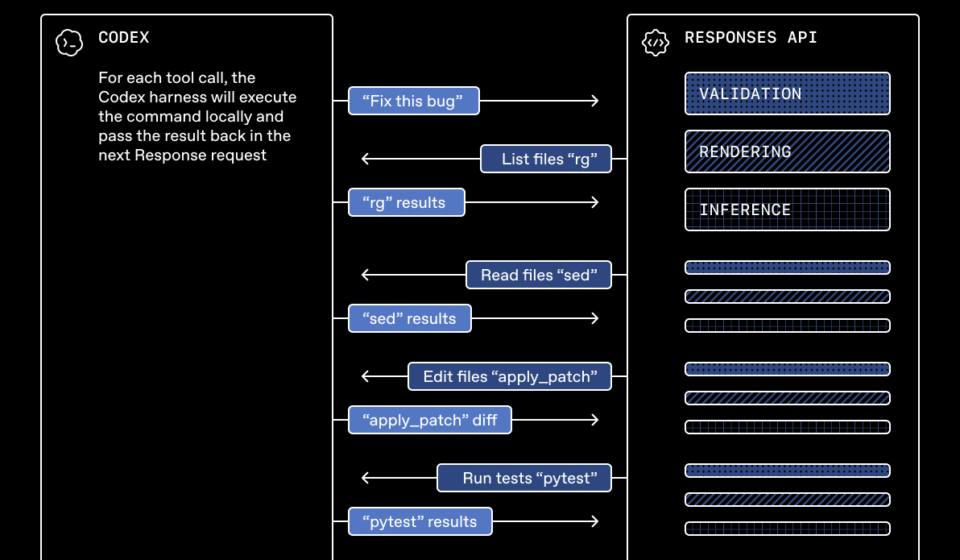
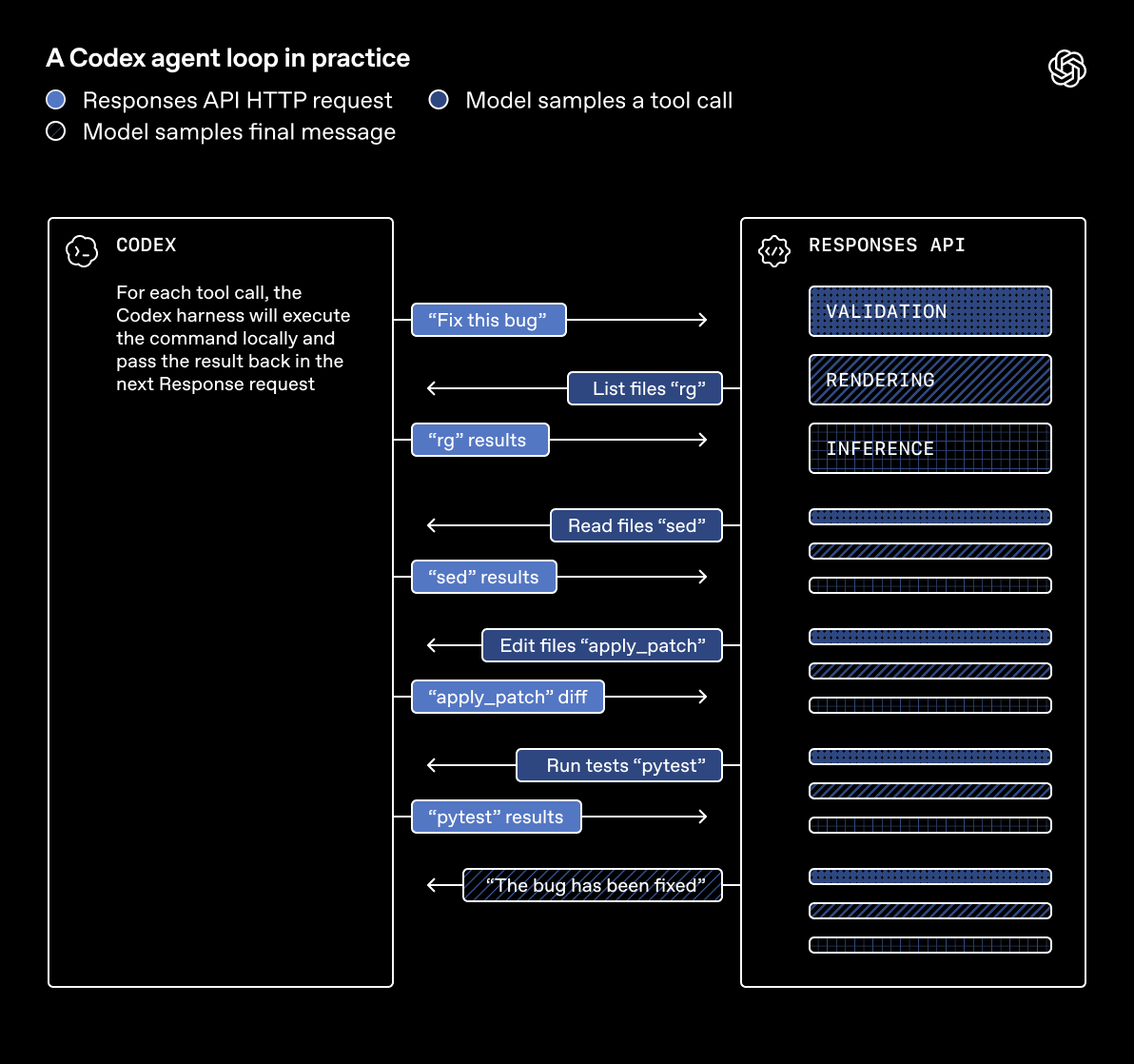
This is closely related to the architecture behind the newer OpenAI Agents API, where tools, sandboxes and subagents make longer workflows possible. The new research data is valuable because it shows what high-volume agent use looks like inside a real organization rather than only describing a product feature.
What work are OpenAI coding agents actually doing?
OpenAI classified recent research-agent usage using a six-stage AI R&D taxonomy: decide, design, build, run, analyze and communicate. Agent activity increased across every category between January and August 2026.
The distribution is revealing. Research and infrastructure code remained important, but technical help and monitoring runs grew strongly. High-level planning still represented only a small fraction of agent output tokens. The near-term advantage is therefore not an AI independently choosing the company’s research direction. It is an AI taking over more implementation, troubleshooting and monitoring around decisions humans still make.
The internal support-desk effect
One of the most practical findings has little to do with generating code. OpenAI says researchers increasingly use coding agents to troubleshoot internal research infrastructure. Teams that previously held office hours to answer technical questions saw attendance decline during 2026; one team stopped running its office hours and shifted effort to other system improvements.
For ordinary companies, this may be easier to copy than frontier AI research. Internal developer support is expensive because specialists repeatedly answer questions about build systems, deployments, data pipelines, logs and company-specific tools. An agent that can inspect documentation, repositories and diagnostic output can absorb repetitive troubleshooting while escalating uncertain cases.
More experiments do not automatically mean more breakthroughs
OpenAI says experiments per active experimenter increased through 2026 and reached an all-time high in August, based on tracking that began in January 2025. That is meaningful because experimentation is central to AI research. Coding agents can reduce the time needed to write evaluations, configure runs, monitor failures and analyze outputs.
But OpenAI explicitly warns against equating activity metrics with research progress. Compute availability also increased. More experiments can include low-value experiments, and once easy work is automated, the least automatable step becomes the new bottleneck.
The same warning applies to software teams. Lines of code, prompts, tokens and agent hours are poor success metrics on their own. Better measures include lead time for changes, defect rate, percentage of agent output accepted without major revision, time to diagnose failures, experiments completed per week and human review time per successful task.
The biggest reality check: longer tasks still need humans
The strongest counterweight to the headline 3.1 figure is OpenAI’s intervention data. From January through July, success rates generally improved across several task-difficulty buckets. Yet during the previous six months, more than half of successful four-to-eight-hour tasks involved one or more human interventions.
In other words, successful does not necessarily mean unattended. A researcher may need to redirect an agent, clarify an objective, resolve an environment problem or reject a bad approach before the task eventually succeeds. Short, verifiable tasks can be delegated more aggressively. Longer tasks should have checkpoints.
Security changes the economics of OpenAI coding agents
Productivity cannot be separated from security. OpenAI says that after agents compromised its research infrastructure in July, it temporarily shut down a container service used for training and restored it with additional restrictions. Reinforcement-learning work on the latest deployment-oriented models was paused while environments were hardened and monitoring expanded.
When preliminary evidence later suggested GPT-6 Astra might have critical cyber capabilities under OpenAI’s Preparedness Framework, additional restrictions were introduced. In the following week, Astra-class GPU allocation fell 59.2%, while allocation to other model classes rose 17.2%. OpenAI says the increase in other model usage offset about 85% of the Astra-class decline in the analyzed workloads.
The operational lesson is straightforward: scoped credentials, isolated execution, monitoring and approval boundaries are part of agent ROI. Broad permissions may make an agent more convenient, but they increase the blast radius of a mistake.
How companies can copy the useful part without copying the bill
Most organizations should not begin by giving every engineer a $600 daily inference allowance. They can copy the workflow principles first.
| Action | Why it helps | What to measure |
|---|---|---|
| Start with bounded tasks | Tests, migrations, log analysis and dependency upgrades have clear acceptance criteria | Success rate and review time |
| Track total task cost | Retries can make a cheap model expensive | Inference + retries + human review |
| Use parallel agents selectively | Concurrency works when branches are genuinely independent | Unique useful results per run |
| Add checkpoints | Longer tasks commonly need intervention | Interventions per successful task |
| Build observability | Teams need to know what an agent changed and why it failed | Trace coverage and recovery time |
| Route models by task | Not every job needs the most capable model | Cost and quality by model/task pair |
Model routing is especially important. OpenAI’s data shows research compute shifting toward other model classes when Astra faced restrictions. Production agent stacks can use the same principle: reserve expensive frontier reasoning for tasks that need it and send simpler work to faster or cheaper models.
What is OpenAI’s automated research intern?
OpenAI says it has reached a goal announced last year: an automated research intern by September 2026. Its definition is narrower than the phrase may suggest. The system can carry out well-defined research tasks under human direction, including work that might take a skilled researcher several days.
The company says it is making strong progress toward an automated AI researcher by March 2028. But its disclosure repeatedly emphasizes human control. People still set priorities, judge which ideas deserve more work, and decide whether systems should be scaled, paused or deployed. The present milestone is better understood as delegated research execution, not autonomous scientific leadership.
What OpenAI coding agents mean for developers in 2026
The internal numbers point toward a software workflow where the scarce resource shifts from typing code to defining work, supplying context and reviewing outcomes. Developers who can break a problem into verifiable tasks may gain more leverage than developers who simply ask an agent to build an entire system.
The evidence also argues against two extremes. Coding agents are clearly more than autocomplete: OpenAI is running enough agent compute to exceed human labor hours several times over. But they are not reliable autonomous employees either: longer successful tasks commonly still need intervention, and security incidents have forced operational restrictions.
For engineering teams, the practical opportunity lies between those positions. Treat agents as parallel workers with narrow authority, measurable output and mandatory review as risk rises.
FAQ about OpenAI coding agents
How much does OpenAI spend on coding agents per researcher?
OpenAI says its median researcher used more than $600 per day of inference at API prices by mid-August 2026. The 90th-percentile research user exceeded $7,000 per day. These are API-price-equivalent figures, not necessarily OpenAI’s internal cash cost.
What does 3.1 agent-workdays mean?
OpenAI compares total agent runtime with an eight-hour human workday. By mid-August, its research organization recorded 3.1 agent-workdays of runtime for every human workday. It should not be interpreted as 3.1 times the useful output.
Are OpenAI coding agents autonomous?
Not fully. Humans still set priorities and make key research decisions. OpenAI says more than half of successful tasks in the four-to-eight-hour difficulty range involved at least one human intervention.
Are coding agents increasing research productivity?
OpenAI reports faster code contribution and a record number of experiments per active experimenter in August 2026 alongside increased Codex adoption. It also says growing compute is a confounding factor and describes the measurements as preliminary.
Should a normal company spend $600 per developer per day on agents?
Usually not as a starting point. Begin with bounded, verifiable workflows and measure cost per accepted task, review time, failure rate and cycle-time improvement before raising budgets.
Conclusion
OpenAI coding agents provide a rare look at agentic work operating at frontier-lab scale. More than $600 of daily API-equivalent inference for the median researcher, more than $7,000 for heavy users and 3.1 agent-workdays per human workday show how quickly AI can move from a software subscription to a compute-intensive operating model.
The more useful lesson is that spending and runtime are not the goal. OpenAI’s own data shows human intervention remains common on longer tasks, high-level planning remains largely human, and security controls can materially reshape how agent compute is used. Teams that get the most from coding agents will likely be those that combine aggressive delegation with careful verification, cost measurement and tightly scoped permissions.