
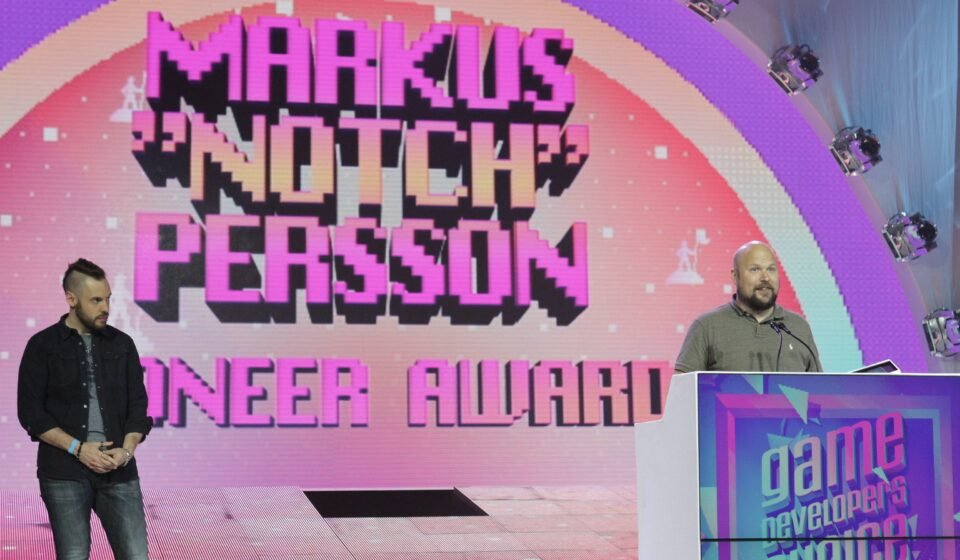

Source: Official GDC via Wikimedia Commons (CC BY 2.0).
The Markus Persson AI programming stance in 2026 is more complicated than a complete reversal. Persson did move away from categorical rejection of AI-assisted programming. He didn't turn himself into a model uncritical advocate of the entire production systems being written by models however. All of his follow-up posts maintain a line: he can play with AI for scoped, repetitive, or ancillary programming tasks, but not for blocks of creative work where he's interested in maintaining human expression, the developer role, and his understanding of a program.
Markus Persson AI Programming Stance: The Short Version
While Markus Persson's attitude to AI programming in 2026 is best described as selective experimentation it is hardly a full-fledged conversion. He stated in January why even using an AI to write code was an awful idea and that he framed programming as a discipline of logic rather than typing. In February, he welcomed what he saw as waning enthusiasm for the current AI wave. On the July 14, he reduced the role to simply two blurted words: “Reject AI.” (Persson’s Jan. 26 AI-coding post on X; Persson’s “AI is dying” post on X; Persson’s July 14 “Reject AI” post on X)
A week later he publicly declared that he would try vibe coding. It's not like he's lost his passion for programming. It was useful: He was finding it hard to get good programmers working for him, and he could envision using an AI system to generate some mundane internal tools he would need to create, like a map editor or a node-graph visualizer. (Persson’s July 21 vibe-coding post on X)
It is in this capacity that this distinction is the only way to grasp what changed. Persson didn’t start off by saying, “AI is now a better programmer than humans.” He proposed delegating tedious support tooling while keeping the interesting code and decisions for himself. Later, he tried playing with Claude, and considered using Claude to convert TypeScript to JavaScript, and that an AI-based WebStorm plugin for syntax highlighting for WGSL, was truly useful. (Persson’s July 27 Claude experiment on X; Persson’s August “proper shot” post on X)
His reservations were still apparent by late August. In a reply to game designer Jonathan Blow, Persson said that one reason he did not want to embrace AI too much was that he preferred to stay a developer rather than become “middle management.” (Persson’s Aug. 26 reply on X)
Timeline at a Glance
| Period | Persson’s public position | What it suggests |
|---|---|---|
| 26 Jan 2026 | Strong warning against AI-written code. | Understanding and logic matter more than code-generation speed. |
| Early 2026 | Celebrates what he sees as weakness in the current AI hype cycle. | Skepticism extends beyond coding to the wider AI boom. |
| 14 Jul 2026 | Posts “Reject AI.” | Categorical public rejection. |
| 21 Jul 2026 | Says he may try vibe coding because hiring is difficult; names map/editor tooling as possible uses. | First clear move toward bounded, practical experimentation. |
| 27 Jul 2026 | Experiments with Claude and considers TypeScript-to-JavaScript conversion. | AI becomes a real workflow tool, not just a debate topic. |
| Mid Aug 2026 | Says he is willing to give vibe coding a proper shot; praises an AI-built WGSL syntax-highlighting plugin. | Evidence changes his view when the tool solves a concrete problem. |
| 26 Aug 2026 | Says he wants to remain a developer rather than become middle management. | Adoption still has a philosophical limit: preserve hands-on craft and agency. |
Why Persson’s View Matters to Programmers
Persson is not followed because he is an AI researcher or the chief executive of an AI company. His public persona was established through software and games, and that is why his programming views attract attention. Two older YouTube interviews help explain the difference. In a GDC 2011 interview, he discussed his route into game development and offered advice to aspiring developers. A 2012 GDC interview focused on his entry into the industry and life after Minecraft. (GDC 2011 YouTube interview with Markus Persson; GDC 2012 YouTube interview with Markus Persson) The videos paint him as a maker first; as someone whose public reputation is based on construction and experimentation, not on a large enterprise engineering organisation.
That context affects the way that people read his AI comments. The controversy is partly about the identity of the programmer when a developer with hands-on experience in construction declares that AI-written code poses a threat to logic and understanding that lie at the core of programming. The difficult tooling problem was solved by an AI tool, and when it's acknowledged by the same developer and actually because of the use and they aren't trying to rebrand it or incentivize it, then it's also a change of importance.
This is why it's worth discussing this issue even though you aren't into Minecraft. It reflects a question experienced programmers face: if an AI system can generate a working implementation, which parts of software development should still belong to the human programmer? It may vary for a throw-away editor, a migration script, a game-specific back-end in the game and the mechanism itself. Persson's posts are becoming more nuanced, however, in distinguishing between code that's written using AI and other codes.
Phase One: Programming Is Logic, Not Typing
The best evidence for Persson's first argument is a tweet from Jan. 26 on X. He only warned that using AI to write code was still an extremely poor idea, and railed against individuals who were touting the practice. In a similar vein, he compared delegating code to AI with delegating laws to AI. (Persson’s Jan. 26 AI-coding post on X) We've taken the analogy one step further in an earlier post where he wrote that letting an AI write code is “insane” for the same reasons that apply to writing laws with AI. (Persson’s AI-and-laws analogy on X)
The argument is not about missing an efficient typing method; Persson clearly framed programming as a logical problem. This is a significant difference. Predictive models for useful text are the obvious substitutes for a human, if code is simply viewed as text. Programming is a process of developing models of a system, establishing constraints, predictions of failures, finding causes of failures, and understanding trade-offs, so getting to code is just one part of the process.
That's the attitude behind his more recent experiments, which can and do come back around to inform earlier statements. A programmer can believe that blindly accepting generated code is dangerous while still using a model to produce a small tool that can be inspected, tested and discarded if necessary. The risk profile is different. The important variable becomes not whether AI touched the code, but how much control and understanding the developer retains.
Phase Two: “Reject AI” Was the Clearest Public Line in the Sand
Persson wrote an unusually succinct statement on X on July 14, 2026, reaffirming his stance of “Reject AI.” (Persson’s July 14 “Reject AI” post on X) It garnered significant engagement and its stance was easy to read. The terms themselves had none in them. This seemed to be reactions against the technology rather than against any specific coding product.
His February post also distinguished AI itself from the current version being pushed at users by companies and investors, while describing the current form as “dying” and welcoming its decline. (Persson’s “AI is dying” post on X) That suggests some of his hostility was aimed at the hype cycle, incentives and deployment culture around generative AI rather than at every possible machine-learning technique.
That difference was more apparent when he's at least venturing out to use the tools himself. That's why the post of 14 July is an appropriate gauge of his emotional and rhetorical stance, but it is not to be interpreted as an unchangeable technical policy. He was soon imagining a scenario that could benefit from AI coding as early as days later.
The July 21 Pivot: Hiring Problems Created a Practical Use Case
The most important turning point in the story came on July 21. Persson noted he'd try out vibe coding, but stated it was not because he didn't like programming. That was not the matter, he said, but that he had a problem recruiting good programmers. Now he said he could dream up such useful tools for the game, which are currently boring and repetitive to create, like a map editor or a node-graph visualizer, with the help of AI. (Persson’s July 21 vibe-coding post on X)
This is more specific than a generic endorsement of AI coding. He identified both the constraint and the workload. The constraint was a lack of suitable human talent, while the workload involved auxiliary tooling rather than the creative core of the game. It is essentially a make-or-buy decision for the AI era: if a task is necessary but not strategically interesting, can automation reduce the cost of getting it done?
It is also interesting to note that first he suggested the tools for himself as his use case. Unlike customer facing production code, the blast radius of internal tools is usually smaller. The developer using a private map editor can detect, correct and remove such an editor. But this isn't always the case for generated code; it's how the programmer handles that code.
There's the hiring comment, too. A lot of the discussion regarding AI-coding is wrapped in the disagreement over companies as substitutes for developers. On the other hand, Persson's post is about a different philosophy: A developer who has a need for programmers but cannot find the right programmers and therefore thinks about using an AI system to get it done. Certainly that doesn't final the labour-market debate, but it is a higher degree convincing than merely nebulous fears of staff swaps.
Claude Turned the Debate into an Actual Workflow
Persson's experiments turned to reality on July 27th. He explained in an X post that there were some ideas of how to use it and that Claude should see what it's capable of, including the idea of converting TypeScript into JavaScript. He concluded with giving a joke/idea on how he could still poke fun at vibe coders if he got about that much vibe. (Persson’s July 27 Claude experiment on X)
The point of the joke is that it recognizes the contradiction and does not try to ignore the earlier criticisms. Most important, the example is once more a transformation task having a clearly defined target. It is less hard to evaluate a conversion of one language variant to another, than to ask a model to invent a complicated architecture completely from scratch. A human can compare behaviours, to run tests, to view a diff, and to reject output based on suspicion.
The narrow task/observable result/human review pattern is very different than the popular caricature of vibe coding which involves a non-programmer bunging and prompting a model until an application works. Persson was coming at the tool as an experienced developer capable of assessing the product. The change itself is a key element in any reasonable reading of it.
The “Proper Shot” Post Shows What Finally Impressed Him
By middle-August, he said he was ready to take Vibe Coding for a serious look; he still didn't know where it fit in. He stated that he could create some great demonstrations with technology but wondered what some of those demonstrations would be used for. That uncertainty is a useful sign of continued scepticism: if something is only a technical spectacle, that does not make it valuable to him. (Persson’s August “proper shot” post on X)
In the same post, however, he described one experience as exceptional. He felt dismayed about the limited attention paid to syntax highlighting in his preferred language, WGSL, and didn't want to develop a WebStorm plugin; besides, it would be really nice to have one. It was created in one go by the AI, and he publicly admitted that it was useful and cool. (Persson’s August “proper shot” post on X)
This is perhaps the most telling instance throughout the history. The tool was successful because there were three characteristics of the problem: It was annoying, well-bounded and easy for an expert user to evaluate. Persson had a clear idea of what syntax highlighting should look like, but had not wished to invest his time in creating the integration. The AI did not take the place of his creative thinking; it removed a low-value barrier between him and his work goal.
This experience fits his emerging stance. Trust will become earned, one task at a time when integrating AI. sweeping statements like “AI can code” aren't nearly as convincing as a model that can solve a particular irritation in minutes. This is also one reason that advanced coders can be cynical at the system level and excited at the level of the individual automation.
Why This Is Not a Complete Pro-AI Conversion
The best argument against describing Persson as fully converted is that he replied to Jonathan Blow on Aug. 26. Persson mentioned one of the reasons he didn't want to jump on the AI trend even more is that he would like to remain a developer instead of being middle management. (Persson’s Aug. 26 reply on X)
That's actually about more than code quality, it's a fear. AI-powered development can alter the role of a developer. In a slightly different scenario, a developer could spend an additional amount of time on assigning work to their agents, reviewing work generated and coordinating the automated agents, and spend less time implementing, debugging, and mastering new systems and functions. People might appreciate that. But not according to Persson, who says in his comment that he doesn't.
His concern also ties in with his personal maker identity. The GDC interviews from 2011 and 2012 deserve to be looked at not as a sign of foreshadowing generative AI, but rather to the importance of doing by hand to his sense of the work. When the pleasure of programming is found in exploring a system in real time, then an automation that takes the implementation out of the equation might take the value of programming too. (GDC 2011 YouTube interview with Markus Persson; GDC 2012 YouTube interview with Markus Persson)
So, the current position reflects two values. Time is of the essence: boredom of tooling, repetitive conversions and missing editor features offer valid ways to save time. Agency also plays a role—that’s why it’s imperative for the programmer to be aware of the system, and that they are the one who makes the consequential decisions. The greater the amount of time that a person needs to be shifted out of his role as a builder and into his role as a supervisor, the less attractive it seems to him.
Reddit Reaction: The Community Sees Both Security Risk and Normal Experimentation
As might be expected, there is a division in the Reddit discussion around Persson’s comments. An r/OutOfTheLoop thread about his earlier claim that AI was dying raised the issue of vibe-coded software being insufficiently audited for bugs and errors. (r/OutOfTheLoop discussion) It is not an empirical security study, but an opinion from a Reddit user, and it captures a concern many developers have faced: code can be generated faster than teams can read and comprehend it.
In an August r/AIdaily_news thread, Persson’s July-to-August activity was framed as a sudden about-face. (r/AIdaily_news discussion) The (useful) takeaway is not the headline of the thread, but the reaction pattern around the thread. Some felt this was hypocrisy some felt this was normal updating from first hand experience. The second analysis has the better support in the sources. Persson didn't delete his previous role in secret. He teased about becoming the coder that he had panned and went on issuing reservations even after discovering useful AI work flows.
In addition, it shares some of the ideas regarding the partitions between personal tools and production software that usually appear in broader vibe-coding conversations on Reddit. Developers often clarify things by writing a script that can handle anything but a commercial application that will have to be secure and accept payments or give users valuable information. Persson's specific offerings—editors, visualizers and an IDE plugin—are on the low-risk end of that range.
What Quora’s Vibe-Coding Questions Reveal About the Bigger Debate
The search results on Quora repeatedly ask when is it a good time to learn programming languages, is it time for vibe coding to replace the need for developers beyond 2026, will vibe coding make the job unviable for developers, or what comes when they create apps on vibe coding, but don't understand the code. (Quora question on programming languages vs vibe coding; Quora question on the future of vibe coding; Quora question about non-coders and vibe coding) Some of these answers did not return consistently from Quora and therefore a Quora consensus is not indicated in this draft. The question titles are helpful as this indicates where there is public doubt.
Persson's trajectory maps for the most part to those questions. The “do we still need to learn languages?” question is related to his point that programming is not about typing. If fundamentals are only syntax memorization, AI can make them look outdated. I think fundamentals would include debugging, system design, and modeling reasonableness of data; if so, AI may increase their usefulness as someone still has to evaluate generated output.
His problem of hiring is the jobs problem. His real-world experience has led him to believe that AI can work as a temporary fix when capabilities are temporarily lost, but no less, expert programmers are not superfluous. Put simply, he is able to utilise AI, which is in itself helpful, as he already knows how to program. He can tell if a generated editor plugin and/or conversion makes sense. A novitiate, working from the same model, might not be aware of what he/she should be interrogating about in the assumptions he/she has made.
Inexperienced people building apps is something that's talked about as well, which is a distinction between access and accountability. AI can reduce the friction to software production; that's actual good. Reducing the barriers to creation does not take away the necessity to be cognizant of consequences. The more a creator does not know about the system that is created, the more critical testing, review and scope limitation becomes.
What YouTube Interviews Add: Persson Has Always Valued Making Things Directly
The videos reviewed in this research are not specific to the subject AI, but rather are historical videos. That is intentional. Persson's journey to making games was explored in his 2011 interview for the GDC and he has offered some words of wisdom for those who would like to create a game. (GDC 2011 YouTube interview with Markus Persson) His journey in the industry and his life since Minecraft's success were the subjects he touched on in the 2012 follow-up. (GDC 2012 YouTube interview with Markus Persson)
These videos are an attempt to make “middle management” more of a reality than a joke. Individual creation and experimentation has always been part of Persson's public image. His interest in the AI is greatest when it can replace him in that mode – such as by generating a missing editor plugin – least when it offers to delegate that role to him.
This context matters because it prevents every new tool use from being treated as a sweeping ideological reversal. Developers will tend towards pragmatic tools, with firm beliefs about craft. You can use code completion without wishing to interact with an autonomous agent, but you can create a migration script without wishing to create the mechanics of a game and let the model create them. Those are themes that become more frequent in Persson's posts written in 2026.
What Persson’s Stance Means for Experienced Programmers
To the practiced programmer, the most useful lesson may be to consider the AI at the task level instead of the ideology level. Persson's change was based upon examples. He was not so influenced by a general discussion as by a utility program that would solve a syntax-highlighting issue that he didn't want to solve by hand.
That indicates a smart operating procedure that should be followed by professionals: to start at bounded tasks where the failure is evident and can be corrected. One-off conversions, boiler plate, editor extensions, data cleanup scripts, and prototypes are easier to review than infrastructure that is security sensitive. Ensure that the source code, tests and architecture remains comprehensible. If the model produces something you cannot explain, that is not a success; it is a warning.
Experts are also required to determine what tasks are those they do not want automated. Efficiency is not the priority, sometimes. Delegating some tasks to other employees could make you more efficient in that specific aspect of programming, but you might not be as happy. Persson’s middle-management comment is a reminder that productivity metrics do not capture the whole value of craft.
What It Means for Beginners and “Vibe Coders”
Beginners should take care not to interpret Persson’s experimentation as a reason to neglect basic programming concepts. The opposite interpretation is stronger. His successful AI uses are effective partly because his programming experience allows him to define tasks and verify whether outputs are useful. AI may reduce implementation time, but his judgment remains the quality-control layer.
AI can also have a lot to offer for the newcomer. It can explain what error messages mean, provide mini examples, create practice projects and explore new APIs. The safest learning loop is asking the model why the code works and running it multiple times, tweaking it and deliberately breaking it and fixing it. This makes AI an interactive tutor and not a black box code vending machine.
The most dangerous type of vibe coding is not using natural language to generate code. It is shipping a system whose behavior is not fully understood by anyone involved in its development. Persson’s early criticism and later experimentation can be reconciled if understanding remains the dividing line.
A More Accurate Label: Selective AI-Assisted Programming
It would be just as simplistic to call Persson “pro-vibe-coding” as to treat “Reject AI” as his permanent position. A more accurate interpretation is selective AI-assisted programming. He has found some AI coding tasks useful, has experimented publicly with Claude, and is willing to continue testing, while still showing discomfort with overdependence and with a future where developers mainly delegate work to agents.
This is significant because, when it comes to public discourse, conversions are often rewarded. An easy story indeed is: “Famous AI critic changes his mind”. The central posts show a slower, more conditional process—that of rejection, curiosity, select trials, a few unexpectedly good outcomes, persistent joking at his own expense, and ongoing boundaries.
The position may change again. It's not a weakness in the analysis, it's part and parcel of the nature of a changing tool in a category so fast. It's best to preserve dates, cite the various posts and also separate the experiments from the endorsements.
Markus Persson AI Programming Stance: Conclusion
It is best to understand Markus Persson’s current attitude as a case where his practice changed more quickly than his underlying philosophy. Early in 2026, he treated AI-written code as fundamentally reckless. By July he was ready for vibe coding, having actual development work to do, little desire to spend his own time on dull tools, and difficulty in hiring people. His experiments with Claude and the successful WGSL editor-plugin experiment provided tangible proof that you could productively delegate some tasks.
His later musings, however, seem to suggest that he doesn't wish to give software development over to the autonomous agents. When he wrote in August that he preferred to remain a developer rather than become middle management, the enthusiasm had been capped. He is looking for leverage without giving up the craft.
The broader programming argument may not be an either-or choice. A third position is beginning to take shape: use models where they remove low-value friction, keep humans responsible for architecture and consequences, and protect the parts of the work where understanding and expression are the point. Persson’s public experiment remains interesting because it is unresolved. He is not simply switching teams; he is testing where the boundary should be.
Related AI Tech Ledger Coverage
- Follow the latest developments in AI News.
- Explore practical developer workflows in AI Tool Guides.
- Browse coverage of AI Agents and Automation.
Original Sources and Community Discussions
- Markus Persson’s January 2026 warning about AI-written code
- Markus Persson’s July 14 “Reject AI” post
- Markus Persson’s July 21 post about trying vibe coding
- Markus Persson’s July 27 Claude experiment
- Markus Persson’s August post about giving vibe coding a proper shot
- Markus Persson’s August reply about remaining a developer
- Reddit discussion in r/OutOfTheLoop
- Reddit discussion in r/AIdaily_news
- Quora discussion question about programming languages and vibe coding
- GDC 2011 interview with Markus Persson on YouTube
- GDC 2012 interview with Markus Persson on YouTube