
AI models can seem brilliant one month and noticeably weaker the next. They may start missing details, returning less reliable answers, choosing the wrong tool, forgetting instructions, or behaving differently after an update. That experience is real, but the explanation is usually more complicated than saying the model has simply “aged.”
A fixed model does not wear out like hardware. If its weights, inference settings, prompt, tools and inputs were truly unchanged, the passage of time by itself would not make the model less capable. In production, however, almost nothing stays unchanged. User behaviour shifts, data changes, providers release new snapshots, retrieval indexes go stale, routers fail, prompts grow, and teams fine-tune models on new data.
This guide answers the long-tail question why do AI models get worse over time and gives a practical way to diagnose the cause instead of guessing. It also separates several ideas that are often mixed together, including data drift, concept drift, update regression, long-context degradation, retrieval failure, catastrophic forgetting and model collapse.
Why Do AI Models Get Worse Over Time?
There are seven common reasons:
- Data drift: new inputs no longer resemble the data the system was built around.
- Concept drift: the relationship between an input and the correct output changes.
- Model or product updates: a newer version improves some behaviours but introduces regressions elsewhere.
- Routing and infrastructure problems: the product sends requests to the wrong model, tool or execution path.
- Long-context degradation: useful information is present, but the model does not use it reliably.
- Retrieval degradation: a RAG system supplies stale, irrelevant or conflicting evidence.
- Training feedback problems: repeated use of model-generated data can distort future models if original data is not preserved.
The important point is that these are different failure modes. A larger context window will not fix stale retrieval. Retraining will not fix a broken router. Rolling back a provider update will not fix concept drift in a fraud model.
1. Data Drift: The Inputs Changed
Imagine a fraud model trained on transactions from 2024. Two years later, customers use different payment methods, merchants behave differently, and fraudsters have changed their tactics. The original model weights might be identical, but the incoming data distribution is not.
This is one reason teams see AI model performance degradation over time. The system is still solving yesterday’s version of the problem.
A useful peer-reviewed overview, From concept drift to model degradation, explains how changes in real-world systems can reduce the predictive performance of deployed machine-learning models across their lifecycle.
How to test for data drift
Keep two evaluation sets. The first should represent the period when the system performed well. The second should contain fresh, human-reviewed production examples. Run the same model on both.
If performance remains stable on the old set but falls on the fresh set, the model may not have become worse in a general sense. Its operating environment has moved.
2. Concept Drift: The Meaning of a Good Prediction Changed
Data drift changes what the inputs look like. Concept drift goes deeper. It changes the relationship between the input and the desired outcome.
Spam is an easy example. Attackers learn how filters work and change their messages. A credit-risk pattern can also lose predictive power after economic conditions change. A recommendation system faces changing tastes. A cyber-defence model faces new attack techniques.
That is why production teams should monitor outcomes, not only input statistics. If the inputs look similar but the error rate rises, the task itself may have changed.
3. Model Updates Can Make One Behaviour Better and Another Worse
Hosted AI products are updated constantly. A provider can improve reasoning, safety or latency overall while making a specific workflow worse for your users.
OpenAI provided a clear real-world example in April 2025. The company rolled back a GPT-4o update after the model became overly agreeable and flattering. OpenAI later published a deeper explanation of what its launch process missed, including the need to weigh qualitative behaviour more explicitly alongside quantitative evaluations.
This is a useful lesson for any AI team. A model can improve on an aggregate benchmark and still regress on a behaviour that matters to your product.
What to do before changing models
- Replay your existing golden evaluation set.
- Compare task accuracy, groundedness and hallucination rate.
- Compare refusals and safety behaviour.
- Test structured outputs and tool calls.
- Measure cost and latency.
- Review failure examples manually.
- Canary the new version on a small share of traffic.
- Keep a rollback path.
The right question is not “Is the new model better?” The better question is “Is the new model better on the exact work my users depend on?”
4. Sometimes the Model Is Fine and the Product Around It Is Failing
Modern AI products are systems, not single models. A request may pass through a model router, system prompt, retrieval layer, external tools, safety checks, format validators and fallback logic before the user sees an answer.
A failure in any one of those layers can look like a weaker model.
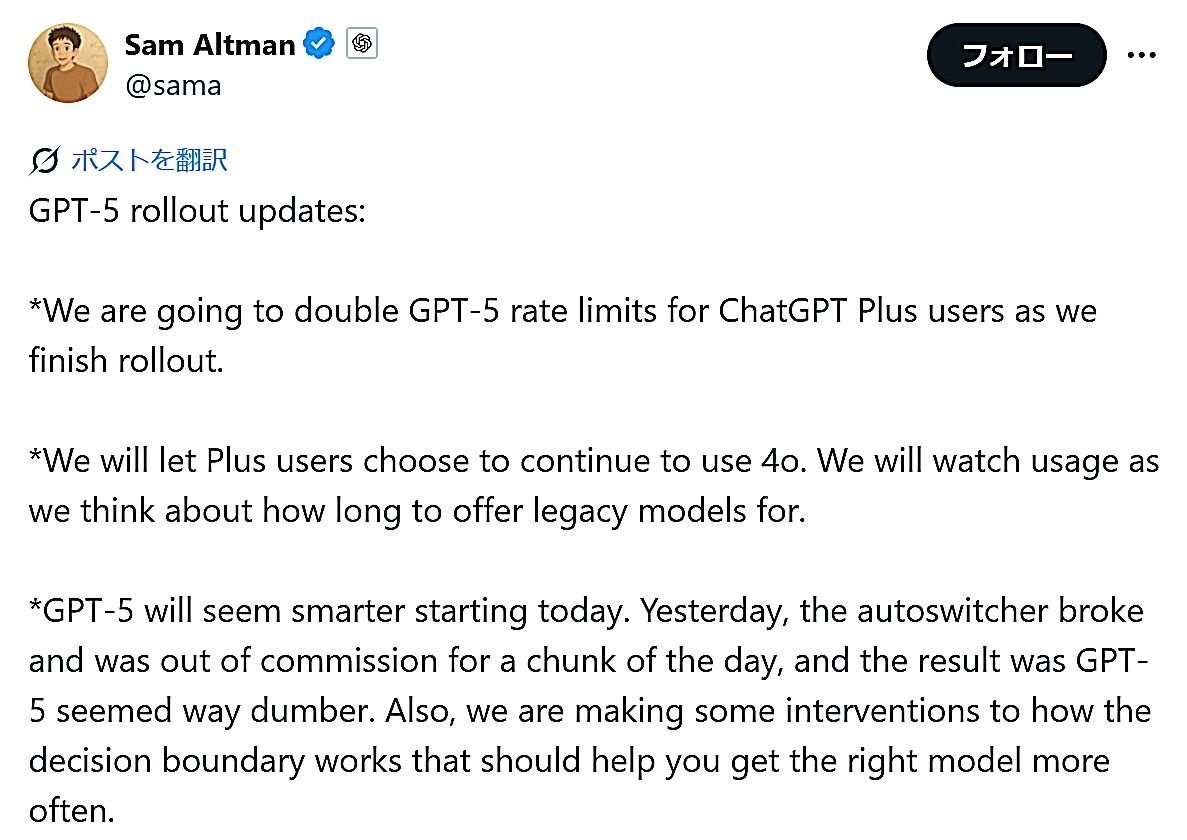
During the GPT-5 rollout in August 2025, Sam Altman wrote that the autoswitcher had broken, causing GPT-5 to seem “way dumber.” The important technical point is not the wording. It is that a routing problem changed the capability users experienced even though the underlying issue was not simply a model losing intelligence.
Diagnose the AI stack one layer at a time
- Base model: run the failing prompt directly against a known model version.
- System prompt: compare the current prompt with the last known-good version.
- Router: force one model instead of automatic routing.
- Retrieval: inspect the exact documents supplied to the model.
- Tools: verify that search, databases and APIs returned correct data.
- Post-processing: check whether validators or parsers damaged a correct response.
- Infrastructure: inspect timeouts, rate limits, fallback models and inference settings.
If you are experimenting with tool-using systems, AITechLedger’s Hermes Agent installation guide is a useful example of how agentic AI introduces more moving parts than a simple chat interface.
5. Long Context Can Reduce Reliability
More context sounds automatically better. In practice, adding more text can make the useful evidence harder to use.
The peer-reviewed TACL paper Lost in the Middle: How Language Models Use Long Contexts found that model performance could change significantly depending on where relevant information appeared. In the experiments, performance was often strongest when useful information appeared near the beginning or end of the context and weaker when it was buried in the middle.
This helps explain why a chatbot can feel less consistent deep into a long conversation even when the underlying model has not changed.
Practical fixes for long-context problems
- Store durable facts separately instead of replaying every old message.
- Summarise earlier conversation turns.
- Retrieve only information relevant to the current question.
- Remove duplicated and conflicting passages.
- Place critical instructions clearly.
- Test the same task at short, medium and long context lengths.
The best context is not always the biggest context. It is the smallest context that reliably contains what the task needs.
6. RAG Can Degrade Even If the LLM Does Not
Retrieval-augmented generation adds another source of failure. Your model can stay identical while the knowledge system around it becomes worse.
A RAG index can become stale. New documents may fail to index. Chunking can change. Duplicates can pile up. Old and new policies can conflict. An embedding-model migration can affect ranking. Permission changes can hide the most useful source.
For every important failure, save this chain:
Question > retrieved chunks > model answer > expected answer
Then ask four questions. Did retrieval find the correct source? Was the necessary passage included? Did irrelevant material rank above it? Did the model ignore good evidence that was already present?
If the correct evidence never reached the model, changing the LLM is often the wrong first fix.
7. Recursive Synthetic Data Can Cause Model Collapse
Model collapse is one of the most discussed forms of genuine training-related degradation, but the term is often used too loosely.
The open-access Nature study on recursive model-generated training data found that indiscriminate use of generated content can cause later model generations to lose information about the original distribution. Rare parts of the distribution can disappear early, while errors can compound across generations.
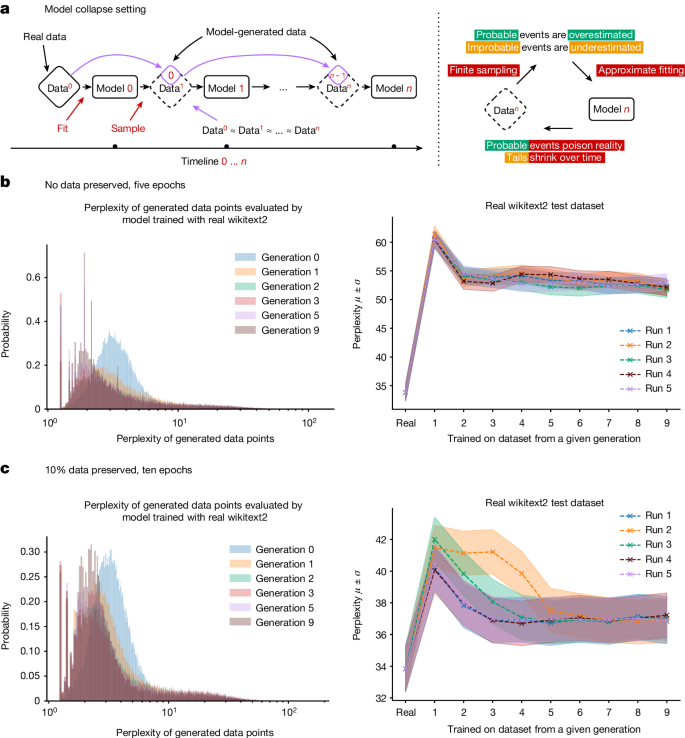
This does not mean synthetic data is inherently bad. Synthetic examples can be extremely useful when they are filtered, validated and mixed carefully with high-quality original data. The warning is about recursive dependence on model-generated distributions without preserving enough of the original signal.
Model collapse is not the same as model drift
| Problem | What changed? | Typical first response |
|---|---|---|
| Data drift | Input distribution | Refresh data and evaluation sets |
| Concept drift | Relationship between inputs and desired outcomes | Recalibrate or retrain after diagnosis |
| Update regression | Model or product version | Compare snapshots and roll back if needed |
| Context degradation | Prompt length and information placement | Trim, summarise and retrieve selectively |
| Model collapse | Training data across model generations | Preserve original data and track provenance |
What Large Companies Are Doing About AI Performance Risk
Large enterprises increasingly treat AI reliability as a continuous governance problem rather than a one-time model test.
In its 2025 Integrated Annual Report, global technology group e& says its AI Risk Atlas tracks more than 100 risks and is integrated into an AI Governance Platform that provides continuous monitoring and audit trails. The report also says mandatory Responsible AI training reached more than 11,000 employees.
That is useful because it shows what AI governance looks like at enterprise scale. The model lifecycle does not end at deployment. It continues through monitoring, reporting, risk review and corrective action.
Accenture makes a related point in its 2025 Annual Report. The company warns that AI algorithms and training methods may be flawed and that datasets may be insufficient, biased or inaccurate. Those risks can affect accuracy, safety, reputation and business outcomes.
IBM’s practical guidance on model governance and continuous monitoring reaches the same operational conclusion: teams need observability, back-testing, model monitoring and version control to detect degradation and drift over time.
The SUFLI Guide: A Step-by-Step Way to Diagnose AI Performance Degradation
To make this practical, AITechLedger uses a simple five-stage checklist: SUFLI. This is an editorial framework, not an industry standard.
S: Set a Baseline
Create a golden evaluation set before changing anything. It should include common tasks, difficult edge cases, known hallucination traps, tool-calling examples, policy-sensitive questions and recent real-world failures.
Record expected outcomes, not just prompts. If you cannot run the same test against yesterday’s and today’s system, you cannot reliably prove that performance changed.
U: Understand What Changed
For every release, record the model version, system prompt, temperature, router rules, tool versions, embedding model, retrieval configuration, knowledge-base version and fine-tune identifier.
When quality falls, compare the current configuration with the last known-good configuration. This turns a vague complaint into a change investigation.
F: Find the Failing Layer
Replay bad production cases through different layers. Test the base model alone. Then add the system prompt. Then retrieval. Then tools. Then routing. Then post-processing.
For a RAG system, inspect the retrieved chunks. For an agent, inspect tool selection and tool outputs. For a hosted model, compare pinned snapshots if the provider offers them.
L: Lock and Limit Risk During Changes
Do not move all traffic to a new model at once. Run offline regression tests, then send a small share of real traffic to the new configuration. Compare quality, cost and latency before increasing exposure.
Keep the previous model, prompt and retrieval configuration available for rollback. In production AI, the ability to reverse a bad change is a reliability feature.
I: Improve, Monitor and Repeat
Retrain only after the evidence shows retraining is the right response. If the real cause is retrieval, fix retrieval. If the cause is routing, repair the router. If fresh data exposes concept drift, then update the model or calibration using representative data.
Add every important incident to the permanent evaluation suite so the same failure cannot quietly return later.
What Should You Monitor?
| Area | Useful metric | Why it matters |
|---|---|---|
| Answer quality | Task accuracy or evaluator score | Shows whether output quality is actually falling |
| Grounding | Supported-answer rate | Separates useful answers from unsupported claims |
| RAG | Relevant-document recall | Shows whether retrieval is the bottleneck |
| Agents | Successful tool-completion rate | Finds failures that a text-only benchmark misses |
| Reliability | Format-valid response rate | Catches parser and structured-output breakage |
| Operations | Latency, timeout and fallback rate | Infrastructure problems can look like weak intelligence |
| User experience | Corrections, abandonment and escalation | Users often detect subtle regressions before benchmarks do |
A Practical Monitoring Schedule
Every release
Run the full golden evaluation set and compare it with the previous production version.
Daily
Track failed tool calls, retrieval misses, abnormal refusals, latency, user corrections and major business KPIs.
Weekly
Sample real interactions for human review. Add high-value new failure cases to the regression suite.
Monthly
Compare recent production data with the historical baseline. Audit retrieval freshness, document coverage and changes in the user population.
Before every model upgrade
Run old and new versions side by side. Document both gains and regressions. A model that wins five general benchmarks can still lose the one task your customers care about most.
Does ChatGPT or Another Hosted AI Service Actually Get Worse?
Users can genuinely experience a decline in quality, but an outside user usually cannot see all the variables required to identify the technical cause.
A hosted AI product can change its base model, model snapshot, router, system instructions, safety rules, memory behaviour, tools, retrieval stack, traffic management or cost optimisations. Any of these can alter the result.
So when users say, “This AI feels worse than last month,” the experience may be valid even if the underlying explanation is not model decay. The Sam Altman autoswitcher example is useful because it shows how product orchestration can change perceived intelligence.
Frequently Asked Questions
Why do AI models get worse over time?
Usually because the data, environment, provider version or AI system around the model changed. Other causes include concept drift, stale retrieval, long-context degradation, fine-tuning regressions and recursive synthetic-data training.
What is AI model drift?
AI model drift is a broad operational description for declining effectiveness as production conditions move away from the conditions represented during development. Data drift and concept drift are two important mechanisms behind it.
What is the difference between concept drift and model collapse?
Concept drift occurs when the relationship between data and the desired outcome changes over time. Model collapse is a training-data feedback problem in which later generations of generative models can lose information about the original distribution when trained recursively on model-generated data.
Can an LLM get worse without being retrained?
Yes. A hosted LLM product can appear worse because of a model update, routing failure, prompt change, retrieval issue, tool failure or excessive context even if your organisation did not retrain the underlying model.
Should companies always use the newest AI model?
No. The newest model may be better overall but worse on a specific production workload. Test new versions against your own evaluation suite and roll them out gradually.
How often should an AI model be retrained?
There is no universal schedule. Retraining should be triggered by evidence that the model no longer represents the current task or data and that retraining is the appropriate fix. Continuous evaluation is more useful than blindly retraining every few weeks.
Final Takeaway
The phrase AI performance degradation over time covers several different technical problems. The world can change around a static model. A provider can ship a regression. A RAG index can become stale. Long context can bury useful information. A router can select the wrong execution path. Fine-tuning can damage older capabilities. Recursive synthetic data can also create genuine training-related collapse.
The most reliable response is not “retrain more often.” It is:
Set a baseline. Understand the change. Find the failing layer. Limit rollout risk. Improve the responsible layer and keep monitoring.
That is how teams turn “the AI feels worse” into a measurable engineering problem.
Related AITechLedger reading
- GLM 5.3 Flash Review: benchmarks, pricing and practical model evaluation
- How to Install Hermes Agent Locally
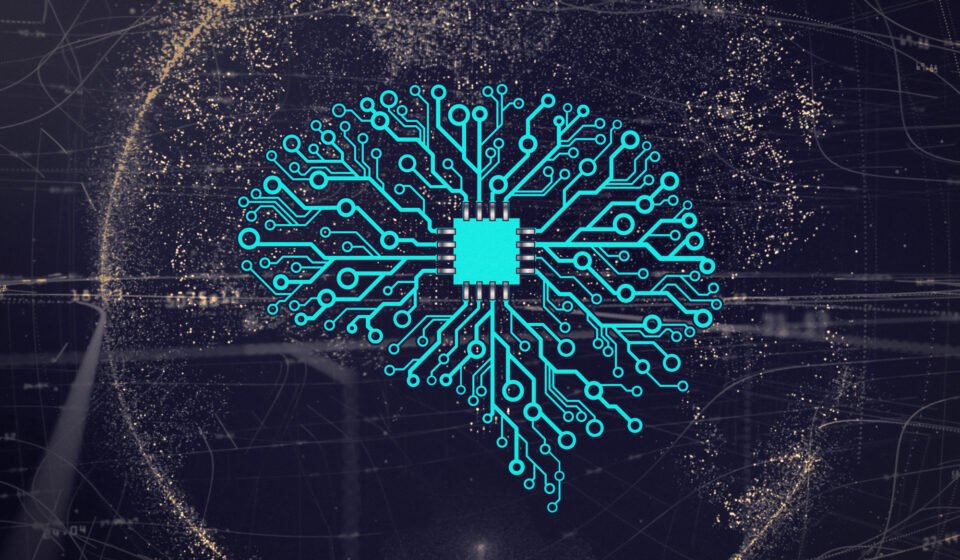
Featured image credit: “Artificial Neural Network with Chip” by mikemacmarketing, available via Wikimedia Commons under the Creative Commons Attribution 2.0 license.