Sakana Fugu Max vs Fugu Ultra v2: Benchmarks, Pricing and Multi-Agent AI Explained

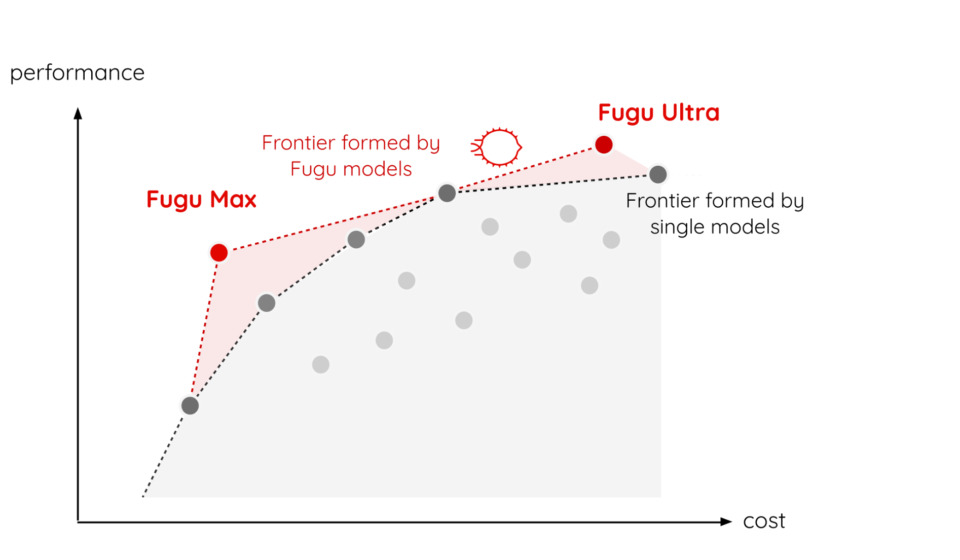
Sakana Fugu Max vs Fugu Ultra v2 is an unusual AI comparison because neither product behaves like a conventional single large language model. Sakana AI’s Fugu system acts as an orchestrator: it can route a problem across different models and agents, combine their work, and return one answer through a familiar API. On September 11, 2026, Sakana AI expanded that idea with Fugu Max, aimed at cost-efficient production workloads, and Fugu Ultra v2, aimed at maximum capability on difficult multi-step tasks.
The timing matters. Developers are increasingly building agents that search the web, inspect files, write code and call tools rather than simply answer one prompt. That changes the buying question from which LLM has the highest benchmark to which system can complete the task reliably at a sensible total cost. Fugu Max and Fugu Ultra v2 are designed around that second question.
This guide examines Sakana AI’s published benchmark results, API pricing, orchestration model and practical trade-offs. Vendor benchmark claims are identified as such rather than treated as independent measurements.
Sakana Fugu Max vs Fugu Ultra v2: quick comparison
| Feature | Fugu Max | Fugu Ultra v2 |
|---|---|---|
| Main goal | Cost-performance efficiency | Maximum capability |
| Input price | $2 / 1M tokens | $5 / 1M tokens at standard context |
| Cached input | $0.25 / 1M | $0.50 / 1M at standard context |
| Output price | $6 / 1M | $30 / 1M at standard context |
| Best fit | Production agents, coding, automation | Hard reasoning, research, complex coding and visual-data tasks |
Source: Sakana AI’s September 11 launch announcement. Prices can change, so production teams should verify the current rate card.
What is Sakana Fugu?
Most AI APIs ask you to select one model before sending a request. Fugu takes a different approach. Sakana describes it as an architecture that can orchestrate a collection of models rather than forcing every problem through one model. A developer can interact with a single service while the system decides how work should be distributed internally.
This is important for agentic AI. A coding task may contain several different subproblems: understanding a repository, planning a fix, writing code, checking tests and reviewing the final patch. The model best at planning is not necessarily the cheapest model for every intermediate step. An orchestrator can theoretically spend expensive intelligence only where it creates value.
Sakana’s thesis is that the rapidly growing pool of open and specialized models becomes more useful when models work together. That puts Fugu in a different category from a straightforward GPT-versus-Claude comparison. It is closer to an intelligent routing and multi-agent layer presented as one model-like endpoint.
What changed with Fugu Max?
Fugu Max is the cost-focused member of the new lineup. Sakana says it reaches performance close to elite models while operating at roughly two to six times lower cost in its evaluated workloads. The company reports the best overall score in its comparison set on six benchmarks: Terminal Bench 2.1, GPQAD, AA-LCR, GDP.pdf, AutomationBench and SWEFish.
Those results are relevant to developers because several tests measure tool use, coding, automation or difficult reasoning rather than simple trivia. Still, they are vendor-reported evaluations. Teams evaluating Fugu Max should reproduce the comparison on their own prompts, tools and failure conditions before a large migration.
The headline pricing is easier to evaluate. Fugu Max costs $2 per million input tokens and $6 per million output tokens, with cached input at $0.25 per million. Sakana says its output price is 40% to 60% below Sonnet 5, GPT-5.6 Terra and Kimi K3 in the company’s launch comparison.
What changed with Fugu Ultra v2?
Fugu Ultra v2 takes the opposite approach. Instead of optimizing primarily for cost, it is designed for difficult multi-step reasoning, autonomous research, software engineering and problems involving structured or visual data.
One of Sakana’s most striking published results is Chartography, a benchmark involving visual reasoning and data interpretation. Fugu Ultra v2 scored 48.3 in Sakana’s evaluation, compared with 27.3 for Claude Opus 5 and 29.5 for Claude Fable 5. On DeepSWE, which targets real-world software engineering, Sakana reports 74.3.
Sakana also says Ultra v2 achieved the best or joint-best result on five of eight published benchmarks and ranked in the top two on seven. Importantly, Sakana says Claude Fable 5, Claude Fable 5.1 and GPT-6 Astra were not included in Ultra v2’s underlying model pool for those results.

Fugu Max vs Fugu Ultra v2 benchmark results
| Published result | Fugu model | Why it matters |
|---|---|---|
| Best overall on Terminal Bench 2.1 | Fugu Max | Agent/tool-use workloads |
| Best overall on AutomationBench | Fugu Max | Automation-oriented tasks |
| Best overall on SWEFish | Fugu Max | Sakana’s internal coding challenges |
| 48.3 on Chartography | Fugu Ultra v2 | Visual and structured-data reasoning |
| 74.3 on DeepSWE | Fugu Ultra v2 | Real-world software engineering |
The key phrase is published result. Benchmarks help identify systems worth testing, but they do not predict every production workload. Agent systems are especially sensitive to prompts, tool definitions, latency, retry behavior, context size and environment quality.

Fugu Max pricing: why $2/$6 matters
For a high-volume application, output pricing can dominate the bill. At $6 per million output tokens, Fugu Max is positioned as an economical orchestrated system rather than a premium frontier endpoint.
Consider a simplified workload that sends 10,000 input tokens and receives 3,000 output tokens. At list rates, the visible token calculation for Fugu Max is about $0.038: $0.020 for input and $0.018 for output. Multiply that by 100,000 runs and even small rate differences become material.
But there is an important caveat with any orchestrated architecture: price per token is only one part of total cost. If a system uses more tokens internally because several agents debate, verify or retry work, effective cost per completed task can differ from a simple single-model calculation. Buyers should track cost per successful task, not just cost per million tokens.
Fugu Ultra v2 pricing and the long-context trade-off
At standard context, Fugu Ultra v2 is listed at $5 per million input tokens, $0.50 per million cached input tokens and $30 per million output tokens. It is clearly a premium option compared with Fugu Max.
The practical decision is not which one is cheaper. Max wins that question by design. The better question is whether Ultra v2’s additional capability reduces retries, human review or failed tasks enough to justify its higher price.
For a research agent working on a difficult PDF, chart or large codebase, a more expensive first attempt can be cheaper than three weak attempts plus manual repair. Conversely, paying Ultra rates for routine extraction, classification or simple coding is difficult to justify if Max completes those jobs reliably.
Why multi-agent orchestration could matter more than the next LLM
The AI market has spent years treating model selection like a leaderboard. Agentic software changes that. Once a task involves ten tool calls, multiple files and a long execution path, reliability depends on far more than the intelligence of one completion.
An orchestration layer can specialize work. A cheap model might classify a request, another might retrieve information, a stronger reasoning model might solve the difficult portion, and a verifier might inspect the answer. The user still sees one final response.
This resembles conventional distributed software: different services handle different jobs. The challenge is that AI routing is probabilistic. Poor orchestration can waste tokens, increase latency or create new failure modes. Good orchestration can make a collection of cheaper models outperform a more expensive monolithic approach on a specific workflow.
This shift connects with AI Tech Ledger’s coverage of OpenAI’s Agents API and AI agent energy consumption. The important unit is increasingly the completed workflow rather than the individual model response.
Fugu Max vs GPT-6 Astra and Claude Fable 5.1
It would be misleading to declare Fugu Max universally better than GPT-6 Astra or Claude Fable 5.1 from Sakana’s benchmark charts alone. These products have different architectures, ecosystems and operational characteristics.
Astra and Fable are frontier model choices with broad developer ecosystems. Fugu is selling orchestration: its value comes from deciding how multiple models should cooperate. That can produce an attractive cost-performance point, but teams should measure routing overhead, latency variance and task-level spend.
For a direct frontier-model comparison, see AI Tech Ledger’s GPT-6 Astra vs Claude Fable 5.1 benchmark analysis. Fugu adds a third strategic option: rather than choosing one frontier model, let an orchestration system choose and combine models dynamically.
Where Fugu Max makes the most sense
Fugu Max looks most compelling when a team has repeated agentic tasks and cares about cost per successful workflow. Examples include repository maintenance, internal automation, research pipelines, document processing and tool-heavy assistants.
It may also appeal to teams that want to benefit from the growing open-model ecosystem without maintaining their own router, evaluation stack and multi-agent coordination layer. Building those components internally creates flexibility, but also engineering and monitoring work.
Before switching production traffic, run a representative evaluation set. Include easy tasks, difficult tasks and deliberately messy cases. Measure completion rate, latency, total billed usage, retries, tool-call failures and human intervention. A model that looks cheaper per token can become expensive if it fails twice as often.
Where Fugu Ultra v2 makes the most sense
Ultra v2 is easier to justify when the value of a correct answer is high. Complex coding, chart interpretation, long-document analysis and autonomous research are natural candidates based on Sakana’s published results.
For these jobs, compare Ultra v2 against the strongest single-model endpoint already in use. Do not test only answer quality. Record end-to-end time, tool reliability and human corrections. The best system is the one that reduces total work, not necessarily the one that wins a benchmark.
Five things developers should test before adopting Fugu
- Cost per completed task: capture the whole run, including retries and orchestration-related usage.
- Latency distribution: measure p50 and p95, not only an average.
- Tool reliability: test failed APIs, unavailable websites and partial tool results.
- Reproducibility: determine how much output changes across repeated runs.
- Fallback strategy: decide what happens when the system cannot complete a task within budget or time limits.
What Fugu says about the future of AI APIs
Fugu Max may be more important as an architectural signal than as another name on a model leaderboard. AI providers increasingly compete on the economics of completed work: caching, routing, tools, sandboxes, agents and long-running sessions.
If orchestration continues improving, developers may care less about manually selecting a model for every request. They may instead specify a budget, latency target and quality requirement while the platform chooses the model or team of models automatically.
That does not eliminate frontier models. It changes how they are consumed. Expensive models can become specialists called only when a task genuinely needs them, while cheaper models handle routine stages. Sakana’s launch is a concrete test of that idea.
FAQ: Sakana Fugu Max vs Fugu Ultra v2
What is Fugu Max?
Fugu Max is Sakana AI’s cost-performance-focused multi-model orchestration product, released September 11, 2026. Sakana lists it at $2 per million input tokens and $6 per million output tokens.
What is Fugu Ultra v2?
Fugu Ultra v2 is Sakana AI’s higher-capability Fugu tier for complex reasoning, research, coding and visual or structured-data tasks. Standard list pricing starts at $5 per million input tokens and $30 per million output tokens.
Is Fugu a single LLM?
No. The central idea is orchestration. Fugu can coordinate multiple models or agents behind one service instead of relying on one model for every part of a problem.
Does Fugu Ultra v2 beat GPT-6 Astra?
Sakana reports stronger results on several evaluated benchmarks, but that does not establish universal superiority. The figures are vendor-reported and should be validated on the workload a buyer actually intends to run.
Which is better, Fugu Max or Fugu Ultra v2?
Choose Max when cost-performance and production scale are the priority. Test Ultra v2 when difficult reasoning or high-value tasks justify paying more for stronger output quality.
Bottom line
The most interesting part of Sakana Fugu Max vs Fugu Ultra v2 is not that Sakana has added two more AI products. It is the argument behind them: a coordinated team of models can occupy cost-performance points that a single model cannot.
Fugu Max is the practical option to watch because its $2/$6 token pricing makes multi-agent orchestration accessible to workloads where frontier-model costs can become uncomfortable. Fugu Ultra v2 is the capability bet, with particularly strong vendor-reported results in coding and visual-data reasoning.
Neither should be adopted from benchmark charts alone. Test the complete workflow and measure cost per successful task, latency, retries and human intervention. If Fugu’s orchestration consistently reduces those numbers, the architecture may matter more than which individual LLM tops this month’s leaderboard.
Sources and further reading: Sakana AI: Introducing Fugu Max and Fugu Ultra v2; Sakana Fugu overview.