GPT-6 Astra vs Claude Fable 5.1: Benchmarks vs Real Users

By AI Tech Ledger Editorial Team
OpenAI’s GPT-6 Astra and Anthropic’s Claude Fable 5.1 arrived within days of each other and immediately created one of the most important frontier model comparisons of 2026. Both are aimed at demanding coding, research, computer-use, and long-running agent workflows. Both also carry the same headline API price of $10 per million input tokens and $50 per million output tokens.
But the closer you look, the less useful a simple winner label becomes. OpenAI’s own evaluations show Astra ahead on several coding, science, automation, and professional-work tests. The latest Artificial Analysis comparison gives Claude Fable 5.1 a narrow lead on its broader Intelligence Index. Meanwhile, early developers on Reddit and X are reporting meaningful differences in context handling, usage limits, tool calling, Blender workflows, and agent efficiency.
This comparison looks at official benchmark data, independent measurements, GitHub benchmark methodology, and real-world community reports to answer a more useful question: what is the best AI model for coding and agentic work right now?
GPT-6 Astra vs Claude Fable 5.1: quick comparison
| Area | GPT-6 Astra | Claude Fable 5.1 |
|---|---|---|
| Developer | OpenAI | Anthropic |
| Standard API input | $10 / 1M tokens | $10 / 1M tokens |
| Standard API output | $50 / 1M tokens | $50 / 1M tokens |
| Cached input / cache read | $1 / 1M | $0.25 / 1M |
| Context window | 1.05M tokens | 1M tokens |
| Terminal-Bench 4.0 | 57.9% | 55.8% |
| Artificial Analysis Intelligence Index v4.2 | 55 | 57 |
| Best current case | Computer use, coding agents, automation, science | Knowledge work, long-context reasoning, Claude Code, cache-heavy agents |
Method note: benchmark results are not perfectly interchangeable. Vendor tables may use different harnesses, reasoning settings, tool access, grading, and cost assumptions. Where a result comes from OpenAI or Anthropic, we identify it as a vendor-reported result rather than an independent reproduction.
Independent benchmark: Fable 5.1 leads the latest Artificial Analysis Intelligence Index
The strongest independent counterweight to the launch-day marketing comes from Artificial Analysis. Its current Intelligence Index v4.2 combines ten evaluations spanning agentic knowledge work, coding, long-context reasoning, finance, professional document reasoning, scientific reasoning, knowledge reliability, and tool use.
In the direct comparison, Claude Fable 5.1 scores 57 and GPT-6 Astra scores 55. Fable also leads several component evaluations, including AA-Briefcase, GDPval-AA v2, Terminal-Bench v2.1, SciCode, Humanity’s Last Exam, and long-context reasoning. Astra, however, leads on some other components and has a clear generation-speed advantage. Artificial Analysis currently measures Astra at roughly 87 tokens per second compared with about 69 tokens per second for Fable 5.1.

This is why the phrase “Astra beats Fable” is too broad. Astra can win important agent and coding tests while Fable still performs better on a wider independent intelligence composite.
OpenAI’s coding benchmarks give Astra the stronger agent story
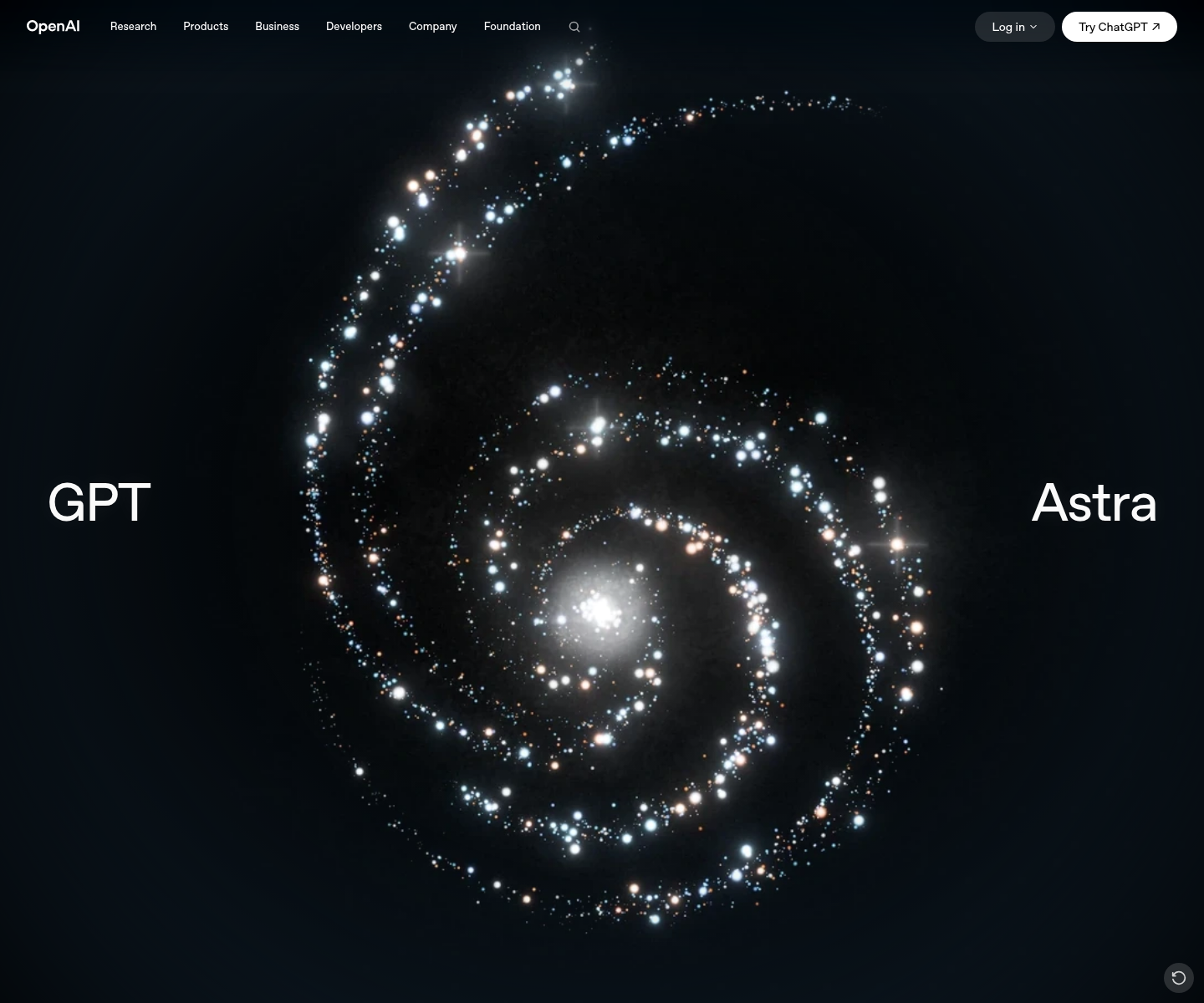
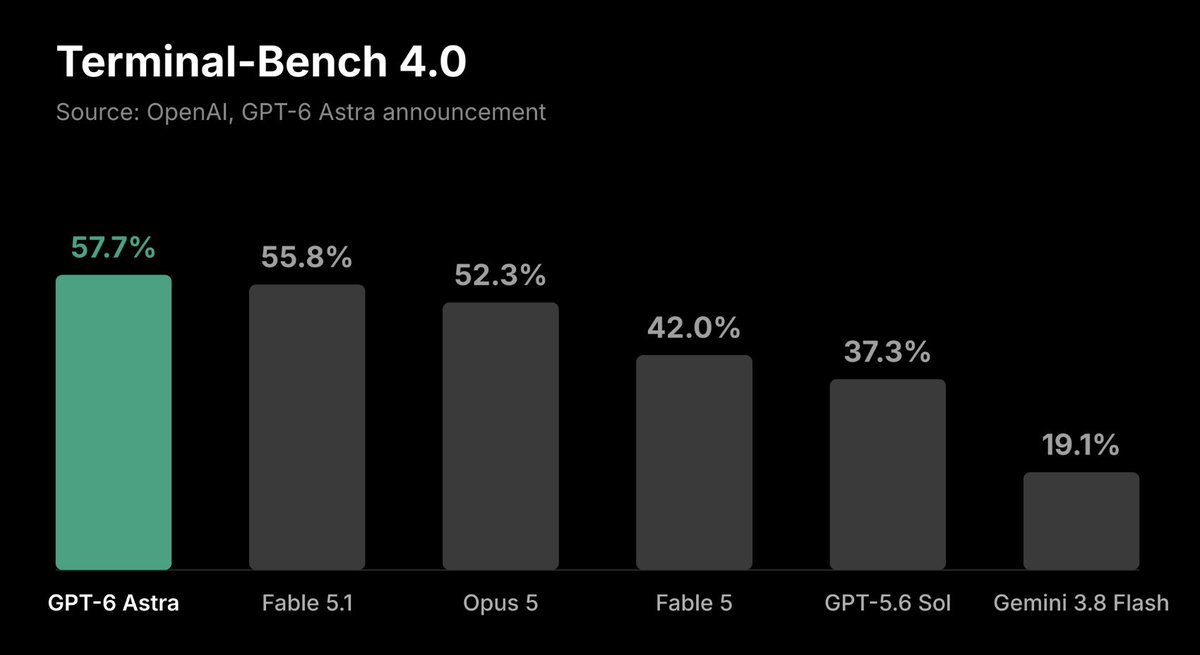
OpenAI’s official GPT-6 Astra announcement positions the model as its strongest system for computer use, software engineering, browsing, cybersecurity, science, and professional work. Its coding table shows Astra at 57.9% on Terminal-Bench 4.0 versus 55.8% for Fable 5.1. Astra also leads Fable 5.1 on DeepSWE v1.1, Terminal-Bench Science 0.1, and FrontierMath Tier 4 v2.
| Benchmark | GPT-6 Astra | Claude Fable 5.1 | Reported leader |
|---|---|---|---|
| Terminal-Bench 4.0 | 57.9% | 55.8% | Astra |
| DeepSWE v1.1 | 74.1% | 67.4% | Astra |
| FrontierCode 1.1 Extended | 64.5% | 63.6% | Astra |
| Terminal-Bench Science 0.1 | 64.6% | 52.6% | Astra |
| FrontierMath Tier 4 v2 | 97.6% | 87.8% | Astra |
| Humanity’s Last Exam, tools | 57.2% | 65.0% | Fable 5.1 |
For readers comparing other coding models, our GLM 5.3 Flash review shows why cost, harness design, and task selection can change the practical ranking even when headline benchmark scores look decisive.
Why Terminal-Bench matters, and why it still does not settle the debate
Terminal-Bench is maintained openly on GitHub through the Harbor framework. It is designed to evaluate frontier agents on difficult terminal-based tasks rather than isolated code-completion questions. Tasks can involve software engineering, system configuration, debugging, data work, and multi-step execution inside controlled environments.

A roughly two-point Terminal-Bench difference is meaningful, but it does not prove Astra will produce better code in every repository. Model choice, reasoning effort, the surrounding coding harness, tool permissions, context management, and retries can all affect the outcome. This is also why developers should be skeptical when a single number is used to declare an overall winner.
Anthropic’s case for Fable 5.1 is broader than one coding score
Anthropic describes Claude Fable 5.1 as a frontier model for coding, knowledge work, and long-running problem solving. Its official results include 55.8% on Terminal-Bench 4.0, 52.6% on Terminal-Bench Science 0.1, 73.4% on CursorBench 3.2.0, and 65.0% on Humanity’s Last Exam with tools. Anthropic also reports strong results in business workflows and computer-use evaluations.

One detail is especially important: Claude Fable 5.1 and Claude Mythos 5.1 are the same underlying model. Anthropic says Mythos uses a different safeguard configuration and is restricted to vetted access programs for advanced cybersecurity and life-science work. Mythos therefore should not be treated as a separate everyday intelligence model when comparing products available to normal developers.
What developers are actually doing with Astra and Fable 5.1
Reddit is already providing examples that benchmark tables cannot capture. One early Fable 5.1 user report described dropping roughly 40 files into a project and asking the model to trace where a calculation was actually performed. The user said Fable followed the call chain rather than guessing from filenames. The same tester also praised Fable for pushing back when a requested change would break a dependency. That is anecdotal evidence, but it illustrates the kind of large, messy context work that developers care about.
A separate Reddit Blender comparison is even more revealing about where frontier models are heading. The poster connected the models to Blender through MCP, described a desired game asset, and said the systems created assets from scratch through tool calls. Commenters then debated visual quality, topology, and the difference between an impressive render and production-ready geometry. This is not a controlled benchmark, but it shows that the Astra versus Fable contest is already moving beyond chat and code completion into multi-tool creative workflows.
Another ClaudeCode discussion described running Astra and Fable 5.1 together on a custom game-server project, communicating through GitHub. That user reported substantially faster consumption of Claude’s session limits while praising Astra’s UI generation and multi-agent usage efficiency. Again, this is one user’s experience, not a benchmark, but usage limits can matter as much as per-token pricing for subscription users.
If you are experimenting with tool-connected agents yourself, our Hermes Agent local installation guide explains the broader agent workflow that makes these model comparisons increasingly practical.
What people on X are saying
OpenAI CEO Sam Altman framed Astra as a model intended to unlock a new generation of entrepreneurship, scientific discovery, and building. In his launch post, he also highlighted OpenAI’s reported FrontierMath Tier 4, ARC-AGI 3, and ExploitBench results. Those numbers are company claims, so they should be read alongside independent evaluations rather than treated as neutral verification.
The coding-agent company Cline focused on a narrower and more useful claim. Its account highlighted Astra taking the top spot on Terminal-Bench 4.0, 1.9 percentage points ahead of Fable 5.1 at the time of the post.
The social reaction is useful because it shows what practitioners are watching: not just raw intelligence, but token efficiency, harness quality, computer use, and whether a model can finish real work with fewer interventions.
Pricing: identical headline rates, very different cache economics
Both models start at $10 per million input tokens and $50 per million output tokens. The biggest pricing difference appears in reused context. OpenAI lists Astra cached input at $1 per million tokens. Anthropic says Fable 5.1 cache reads cost $0.25 per million tokens, a 75% reduction from Fable 5.
| API cost | GPT-6 Astra | Claude Fable 5.1 |
|---|---|---|
| Input | $10 / 1M | $10 / 1M |
| Cached input / cache read | $1 / 1M | $0.25 / 1M |
| Output | $50 / 1M | $50 / 1M |
| Context window | 1.05M | 1M |
Anthropic estimates the cheaper cache reads can reduce typical Fable 5.1 workloads by about 25%, and highly agentic workloads by as much as roughly 45%. That is Anthropic’s estimate, not an independent guarantee. OpenAI also notes that prompts above 272K input tokens receive higher long-context pricing, which matters when comparing million-token workflows.
The practical lesson is simple: compare cost per completed task, not price per million tokens. A model that needs fewer retries or fewer output tokens can be cheaper even when its cache price is higher.
Which is the best AI model for coding and agentic work?
GPT-6 Astra currently has the stronger benchmark case for terminal agents, computer use, scientific coding, and end-to-end automation. OpenAI’s published data shows meaningful leads on several relevant tests, and independent measurements indicate strong output speed and token efficiency.
Claude Fable 5.1 remains extremely competitive for large-context coding, knowledge work, Claude Code workflows, and cache-heavy agents. It currently leads Astra on Artificial Analysis Intelligence Index v4.2 and on several component evaluations, while Anthropic’s cheaper cache reads can materially change the economics of repeated-context workloads.
For a broader explanation of why model quality can feel inconsistent even when benchmarks improve, see our analysis of why AI models sometimes appear to get worse over time.
Final verdict
There is no defensible universal winner yet. The evidence points to two slightly different strengths.
- Choose GPT-6 Astra if your priority is terminal-based agents, computer use, scientific workflows, high output speed, automation, and the strongest current showing across OpenAI’s coding-agent evaluations.
- Choose Claude Fable 5.1 if your priority is large messy contexts, long knowledge-work sessions, Claude Code, cheaper cached context, and strong independent intelligence results.
The more important change is that frontier model comparisons are no longer just model-versus-model comparisons. The harness, reasoning level, tools, MCP connections, context strategy, caching policy, safeguards, and subscription limits can all change which system performs best.
That is why the best AI model for coding and agentic work is increasingly the model that performs best inside your actual workflow, not simply the one with the highest number in a launch-day chart.
FAQ
Is GPT-6 Astra better than Claude Fable 5.1?
Astra leads several official coding, science, and automation benchmarks, while Fable 5.1 currently leads the independent Artificial Analysis Intelligence Index v4.2. The better model depends on the workload and agent harness.
Which model is better for coding agents?
Astra currently has the stronger Terminal-Bench 4.0 and DeepSWE results in OpenAI’s comparison. Fable 5.1 remains highly competitive in Claude Code and leads some independent agent and intelligence evaluations.
Is Claude Mythos 5.1 more powerful than Fable 5.1?
Anthropic says Mythos 5.1 and Fable 5.1 use the same underlying model. Mythos has different safeguards and restricted access for advanced cybersecurity and life-science work.
Which model is cheaper?
The headline input and output rates are the same, but Fable 5.1 has much cheaper cache reads. Real cost depends on cached context, output length, reasoning effort, retries, and how efficiently the agent completes the task.
Sources: OpenAI GPT-6 Astra announcement, OpenAI API model page, Anthropic Fable 5.1 and Mythos 5.1 announcement, Artificial Analysis, Terminal-Bench on GitHub, Sam Altman on X, Cline on X, and the linked Reddit community reports. For how AITechLedger evaluates claims, see our Review Methodology and Editorial Policy.