DeepSeek V4.1 Flash: Price, Benchmarks, API and V4 Pro Changes

By AI Tech Ledger Editorial Team
DeepSeek V4.1 Flash launched on September 10, 2026, turning a short API preview into a production model aimed at coding agents, long-context workflows, and multimodal applications. Reuters reported the launch on September 10, while DeepSeek community posts and Chinese technology reporting say the production API model name is now deepseek-flash.
The release is more important than a normal model refresh. DeepSeek is reshuffling its API lineup: older V4 Flash and V4 Flash Vision Exp identifiers are being routed to V4.1 Flash for compatibility, and V4 Pro requests are expected to move to V4.1 Flash after 12:00 Beijing time on September 14 until a future V4.1 Pro arrives.
That makes DeepSeek V4.1 Flash a migration, pricing, architecture, and benchmark story at the same time. Here is what developers need to know, what the numbers actually mean, and what still needs independent verification.
DeepSeek V4.1 Flash at a glance
| Item | DeepSeek V4.1 Flash |
|---|---|
| Release date | September 10, 2026 |
| Production API model | deepseek-flash |
| Reported total parameters | 552B |
| Active parameters | About 8B during input/prefill; 16B during decode |
| Architecture | MoE with asymmetric Causal Encoder-Decoder design |
| Multimodal support | Native visual understanding |
| Off-peak cached input | $0.003 / 1M tokens |
| Off-peak uncached input | $0.15 / 1M tokens |
| Off-peak output | $0.60 / 1M tokens |
The new model is reported as a 552-billion-parameter Mixture-of-Experts model using a new asymmetric Causal Encoder-Decoder design. During input processing, about 8B parameters are active per token; during decoding, about 16B are active. PChome’s September 10 report, citing DeepSeek’s release information, also says the model includes native visual understanding rather than relying on the separate experimental vision route used with the earlier V4 Flash generation.
DeepSeek says the design cuts the memory cost of long-context inference. The same release reporting says HBM requirements for the KV cache fall to about one quarter of the previous generation and SSD requirements to about one eighth. For agent workloads that repeatedly resend histories, tool results, files, and system instructions, cache efficiency can directly affect concurrency and serving cost.
What changed from DeepSeek V4 Flash?
The previous DeepSeek V4 Flash was already built around long-context efficiency. Its official Hugging Face model card describes a 284B-parameter MoE model with 13B activated parameters and a one-million-token context window. It uses hybrid attention combining Compressed Sparse Attention and Heavily Compressed Attention, plus manifold-constrained hyper-connections and the Muon optimizer.
V4.1 Flash substantially increases total model capacity while activating fewer parameters during input and only modestly more during decoding. In practical terms, DeepSeek is pushing harder on the idea that a model can have a very large pool of learned capacity without paying the compute cost of running every parameter for every token.
The second major change is native multimodality. DeepSeek introduced V4 Flash Vision Exp as an experimental visual model built by adding visual modules to V4 Flash. V4.1 Flash instead treats image understanding as a native part of the new architecture. That is relevant for browser agents, document workflows, screenshot analysis, and UI automation.
The third change is operational. Developers can call the production model using deepseek-flash. Older Flash identifiers are temporarily routed to it, which should reduce immediate breakage for existing applications.
DeepSeek V4.1 Flash pricing: why the cache number matters
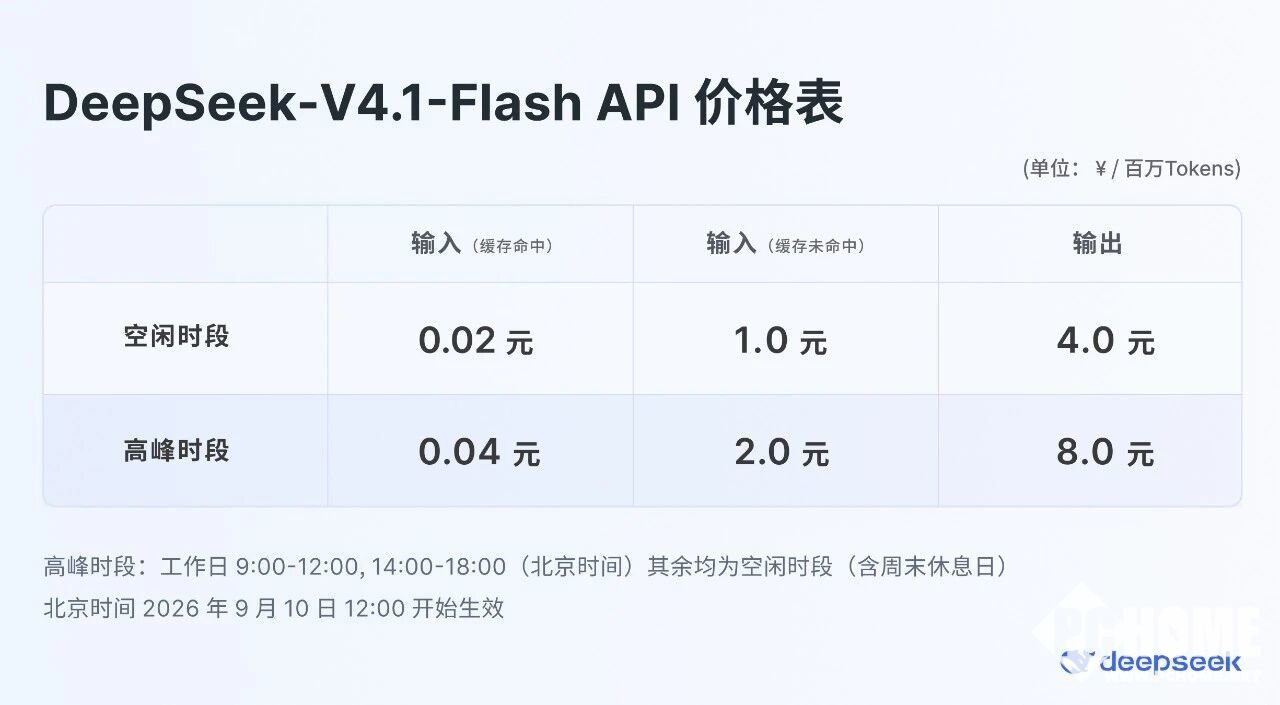
DeepSeek has also cut Flash pricing. Reports based on the company’s September customer notice put the new off-peak rates at $0.003 per million cached input tokens, $0.15 per million uncached input tokens, and $0.60 per million output tokens. Peak rates are double those amounts.
| Token type | Off-peak | Peak |
|---|---|---|
| Cached input | $0.003 / 1M | $0.006 / 1M |
| Uncached input | $0.15 / 1M | $0.30 / 1M |
| Output | $0.60 / 1M | $1.20 / 1M |
Peak hours run Monday through Friday from 01:00-04:00 UTC and 06:00-10:00 UTC. All other periods are off-peak. DeepSeek’s official API pricing documentation should be treated as the final reference because the provider notes that prices can change.
The standout number is cached input. Long-running agents often reuse the same system prompt, repository context, documentation, and conversation history. If much of that prefix is served from cache, the input portion of a workload can become extremely cheap. Still, developers should not compare providers using cached-input price alone. Output tokens, retries, tool failures, latency, and completion rate all affect cost per successful task.
For reference, the previous V4 Flash pricing page listed $0.007 per million cache-hit input tokens, $0.22 per million cache-miss input tokens, and $0.66 per million output tokens during off-peak hours. The new schedule lowers all three, with the biggest proportional reduction on cached input.
What happens to DeepSeek V4 Pro?
This is the part API users should watch most closely. DeepSeek says V4.1 Flash performed better than V4 Pro across performance, cost, speed, and total task time in its own testing. As a result, V4 Pro is being retired in an orderly way.
After 12:00 Beijing time on September 14, requests sent to deepseek-v4-pro are expected to route to V4.1 Flash until V4.1 Pro is released. Those requests will be billed at V4.1 Flash prices.
That is financially attractive, but a backend swap is still a production change. A stable model identifier does not guarantee identical behavior if the provider changes the model behind it. Teams using V4 Pro for validated prompts, structured outputs, creative writing, compliance-sensitive workflows, or agent chains should run regression tests before and after the switchover.
That concern is already visible on Reddit. One V4 Pro API user reported a sudden quality change and initially suspected a model swap. Community discussion was confused because model handles and documentation were changing during the rollout. One anecdote cannot establish a broad quality problem, but it shows why version transparency matters.
DeepSeek V4.1 Flash benchmarks: promising, but not the final word
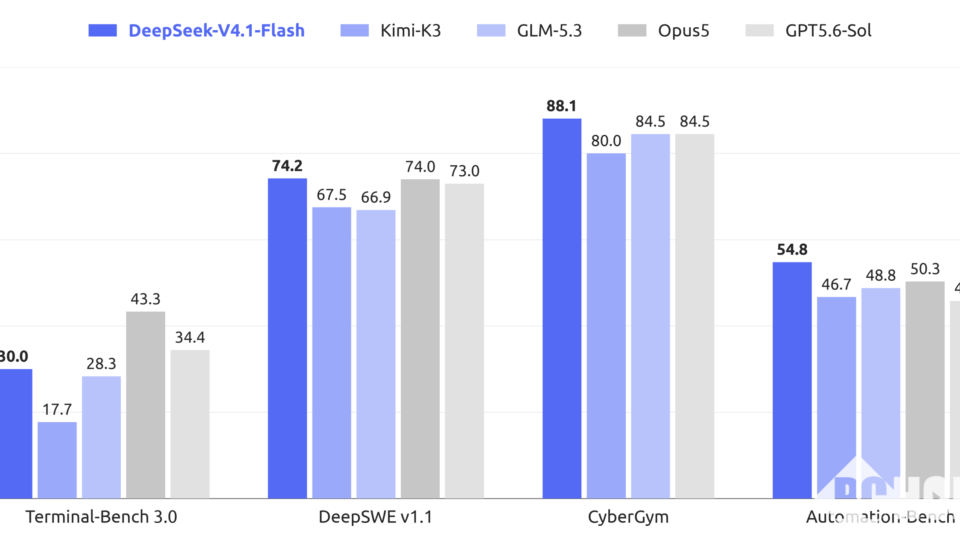
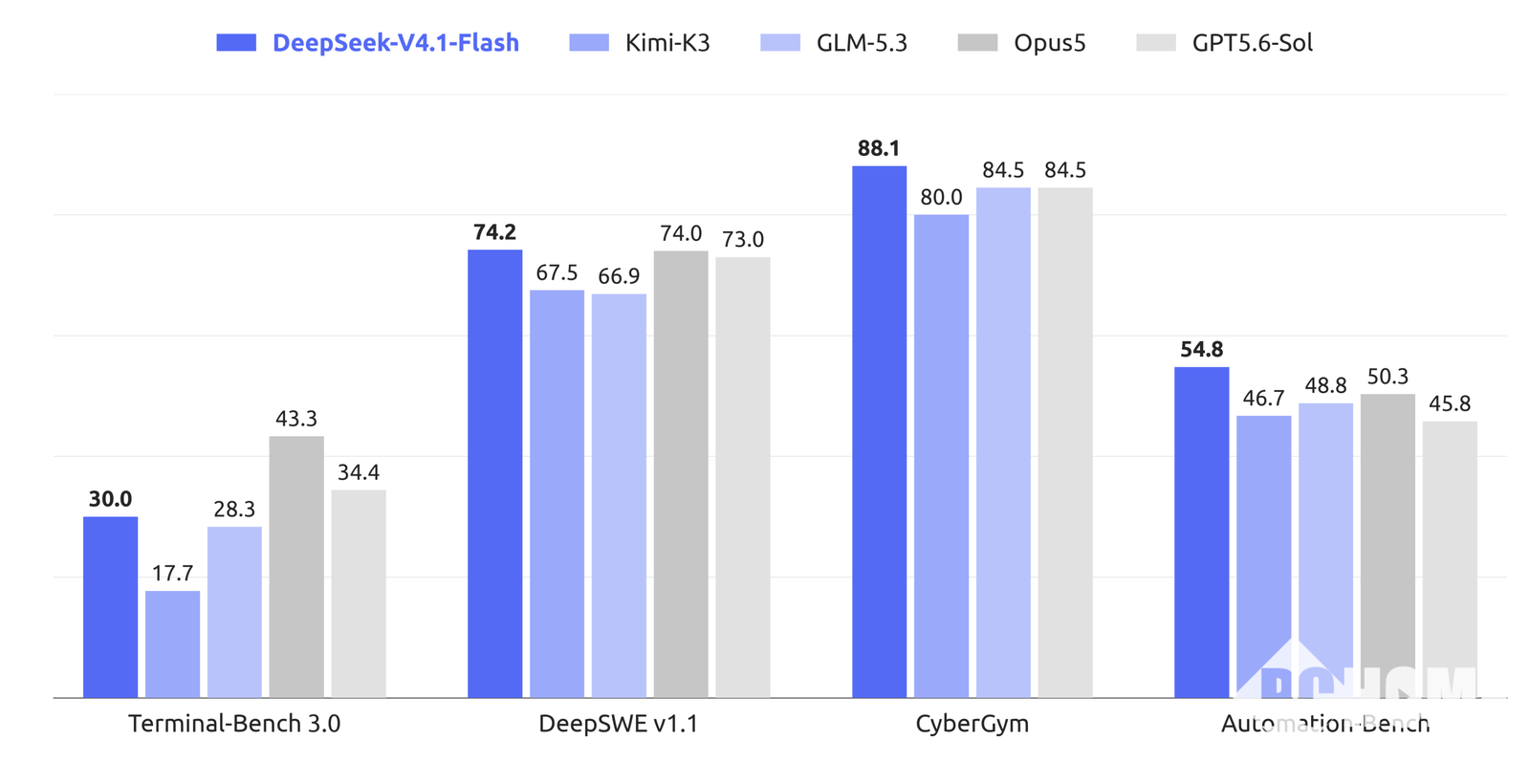
Early release figures put DeepSeek V4.1 Flash at 90.6 on Terminal-Bench 2.1, 74.2 on DeepSWE v1.1, and 65.4 on NL2Repo. PChome and DeepSeek community posts attribute those numbers to the company. They point to a substantial jump in agentic coding performance over the older V4 Flash generation.
| Benchmark | V4.1 Flash release figure | V4 Flash 0731 |
|---|---|---|
| Terminal-Bench 2.1 | 90.6 | 82.7 |
| DeepSWE | 74.2 | 54.4 |
| NL2Repo | 65.4 | 54.2 |
The older values come from DeepSeek’s V4 Flash 0731 model card. If the new numbers were measured under comparable settings, the improvement is meaningful.
But launch-day benchmark numbers should not be treated as independent proof. Harnesses, reasoning settings, tool permissions, retries, and token budgets can all move results. Broad independent evaluation of the final V4.1 Flash build was still limited on release day. The useful conclusion is that the reported agent scores are strong enough to justify testing, not that the model has conclusively beaten every competitor.
Why DeepSeek V4.1 Flash is trending with developers
The release generated immediate discussion in local-model and coding-agent communities. A LocalLLaMA thread focused on the unusual active-parameter counts and hardware implications. An Unsloth thread passed 100 votes within hours, while OpenCode users discussed immediate V4.1 Flash availability.
The interest makes sense. Developers increasingly judge models on capability, speed, and cost at the same time. A model can be slightly weaker on a broad intelligence score yet still be the better production choice if it completes agent tasks quickly and cheaply. Conversely, a very low token price means little if a model requires repeated retries or produces unstable structured output.
DeepSeek V4.1 Flash is explicitly designed around that tradeoff: sparse activation, aggressive cache efficiency, and native multimodality aimed at sustained agent work.
Can you run DeepSeek V4.1 Flash locally?
DeepSeek’s open-model strategy makes local deployment an obvious question. The new model is appearing through DeepSeek’s Hugging Face ecosystem, but Flash does not mean small.
A model with hundreds of billions of total parameters remains a substantial deployment target even when only a fraction of parameters are active for each token. Sparse activation reduces compute per token, but the model weights still need storage and an inference stack capable of moving the required experts efficiently.
That means a typical consumer PC should not be assumed to run the full model comfortably. Quantization and SSD offloading may help, and the new architecture is designed to reduce cache pressure, but serious local deployment remains a hardware and software engineering project. For most individual developers, the hosted API will be the practical place to test V4.1 Flash first.
DeepSeek V4.1 Flash API migration checklist
- Build a real evaluation set. Use production prompts, not generic benchmark questions. Include difficult structured outputs, tool calls, long-context requests, and known failure cases.
- Test
deepseek-flashside by side. Track successful task completion, latency, tokens, retries, and total cost. - Verify vision behavior. If your application uses screenshots, PDFs, or UI images, test your own resolutions and file types rather than assuming native multimodality solves every case.
- Check JSON and parser assumptions. Two models can support the same API format while producing slightly different output structures that break downstream code.
- Watch the September 14 Pro routing change. If production still points at
deepseek-v4-pro, treat the provider-side change as a model upgrade and monitor it accordingly.
DeepSeek V4.1 Flash vs GPT-6 Astra and Claude Fable 5.1
It is tempting to turn every frontier release into a single winner, but that would be premature. Our recent GPT-6 Astra vs Claude Fable 5.1 comparison showed why benchmark leadership changes by evaluation. Astra had the stronger showing on several coding-agent and computer-use tests, while Fable led the broader Artificial Analysis Intelligence Index at the time of that comparison.
DeepSeek V4.1 Flash adds a different pressure: price-performance. Its announced API rates sit far below the headline rates of premium frontier models. That matters for high-volume coding agents, extraction jobs, document analysis, and automation where millions of tokens accumulate quickly.
But price comparisons are incomplete without quality-adjusted cost. The metric that matters in production is often cost per completed task: total tokens, retries, and tool calls divided by successful outcomes. Engineering overhead, reliability, and latency belong in that calculation too.
If you are building an actual agent stack, our Hermes Agent installation guide gives a practical example of the kind of tool-connected workflow where model cost and reliability become more important than a single benchmark score.
Who should try DeepSeek V4.1 Flash?
The strongest early use cases are coding agents, browser and visual agents, long-context research workflows, large-scale extraction, API automation, and teams already using DeepSeek V4 endpoints.
It is especially interesting for cache-heavy applications. If the same long prefix is reused across many calls, the extremely low cached-input price can materially change operating costs.
It is less obvious for teams that need a fully independently characterized model on day one. The release is fresh, documentation is still catching up in some places, and independent benchmarks need time. Production teams should test before moving critical workloads.
DeepSeek V4.1 Flash: final verdict
DeepSeek V4.1 Flash is one of the more consequential AI releases of September 2026 because it combines a new architecture, native vision, aggressive cache economics, and an API-lineup change in one move.
The headline numbers are compelling: 552B total parameters, sparse activation of about 8B parameters during input and 16B during decoding, lower Flash API prices, and vendor-reported gains on agentic coding benchmarks. The operational detail is equally important: deepseek-flash is the new production target, older Flash routes are being redirected, and V4 Pro traffic is scheduled to follow on September 14.
For developers, the sensible response is not to declare a benchmark winner. Build a small regression suite, test V4.1 Flash against your real workload, measure cost per successful task, and watch how behavior settles after the routing changes. If DeepSeek’s release-day claims hold up under independent testing, V4.1 Flash could become one of the most aggressive price-performance options for agentic AI workloads.
FAQ
What is DeepSeek V4.1 Flash?
DeepSeek V4.1 Flash is DeepSeek’s new Flash-tier AI model released on September 10, 2026. It uses a new sparse MoE architecture, supports native visual understanding, and is aimed at fast, lower-cost agentic and long-context workloads.
What is the DeepSeek V4.1 Flash API model name?
The production API model name is deepseek-flash. Older V4 Flash identifiers are being temporarily routed to the new model for compatibility.
How much does DeepSeek V4.1 Flash cost?
Reported off-peak rates are $0.003 per million cached input tokens, $0.15 per million uncached input tokens, and $0.60 per million output tokens. Peak rates are double. Always check DeepSeek’s live pricing page before budgeting production workloads.
Is DeepSeek V4.1 Flash better than V4 Pro?
DeepSeek says V4.1 Flash surpassed V4 Pro across performance, speed, cost, and total task time in its testing. Independent evaluation of the final release was still limited on launch day, so teams should verify that claim on their own workloads.
Will DeepSeek V4 Pro stop working?
DeepSeek says requests to the V4 Pro endpoint will route to V4.1 Flash after 12:00 Beijing time on September 14 until V4.1 Pro is released. Developers should treat that as a production model change and regression-test important applications.
Sources: Reuters, DeepSeek API Docs, DeepSeek on Hugging Face, V4 Flash 0731 model card, and PChome release coverage.