ChatGPT for Financial Services: Features, Data, Security and Wall Street Impact

OpenAI launched ChatGPT for Financial Services on September 10, 2026, introducing a finance-specific version of ChatGPT built for investment banking, equity research and other regulated financial workflows. The product combines GPT-6 Astra with premium financial datasets, source-level citations, enterprise governance controls and firm-managed templates for Excel, Word and PowerPoint.
The timing matters. AI adoption in finance has moved well beyond small pilots. FINRA says summarization and information extraction are now the most common generative-AI use cases among its member firms, while the U.S. Treasury spent much of 2026 developing finance-specific AI risk-management resources. On Reddit, the launch immediately triggered questions about what is actually new, whether the output is accurate enough for finance, and whether this kind of system will replace junior analysts.
This guide looks at ChatGPT for Financial Services from that practical angle. It explains what the product includes, how it differs from ordinary ChatGPT Enterprise, what data it can access, how GPT-6 Astra performs on finance-oriented tasks, what security controls OpenAI says are included, and where human review is still essential.
Key takeaways
- ChatGPT for Financial Services is an enterprise product, not a consumer finance plan. It is currently available to eligible financial institutions.
- The biggest differentiator is the data layer. Built-in and entitlement-based financial sources are designed to make research more traceable and easier to audit.
- GPT-6 Astra improves retrieval and financial reasoning, but it is not error-free. High-stakes outputs still need professional review.
- The immediate impact is likely workflow compression rather than instant job replacement. Research, modeling and presentation tasks can move faster, while judgment and accountability remain human responsibilities.
What is ChatGPT for Financial Services?
OpenAI describes ChatGPT for Financial Services as a tailored ChatGPT Work experience for eligible financial institutions. The company says Morgan Stanley and Evercore acted as design partners, helping shape the initial focus on investment banking and equity research.
The product is organized around recurring finance workflows such as value analysis, leveraged-buyout modeling, buyer screening, earnings analysis and pitchbook preparation. Instead of asking a general chatbot to search for information and then manually moving the result into spreadsheets or slides, the aim is to keep data retrieval, analysis, citations and deliverables inside one governed environment.
That distinction is important. A normal ChatGPT conversation can already summarize filings, explain valuation methods and help write spreadsheet formulas. The new product tries to solve the less glamorous enterprise problems around that intelligence: licensed data access, permissions, citations, templates, auditability and repeatable workflows.
ChatGPT for Financial Services at a glance
| Feature | What OpenAI offers |
|---|---|
| Core model | GPT-6 Astra |
| Initial focus | Investment banking and equity research |
| Built-in data | Daloopa, PitchBook, LSEG News, Crunchbase and other sources |
| Existing subscription access | Entitlement integrations with providers including S&P Capital IQ, LSEG, MSCI, Dow Jones Factiva and Moody’s |
| Connector ecosystem | 50+ connectors, including Datasite, Box, Preqin and Intapp |
| Outputs | Research, models, charts, Word documents, Excel files, PowerPoint decks and pitchbooks |
| Security | SAML SSO, SCIM, role-based access, encryption, retention controls and compliance logs |
| Availability | Eligible financial institutions through OpenAI sales/account teams |
Why the financial data layer may be the biggest change
The most useful part of this launch may not be GPT-6 Astra by itself. It is the way financial data is packaged around the model.
OpenAI says ChatGPT for Financial Services includes data from Daloopa, PitchBook, LSEG News and Crunchbase. These sources cover financial statements, earnings transcripts, company fundamentals, private-company information, funding activity and acquisitions. Some of that data is indexed and hosted on OpenAI infrastructure so the product can retrieve it quickly and attach granular citations.

That matters because a finance team cannot rely on a polished answer if nobody can trace the number behind it. A banker normalizing EBITDA, for example, needs to see the reconciliation and the notes behind excluded costs. OpenAI’s product is designed to let users move back to the exact table or passage supporting a figure instead of treating the model’s answer as a black box.
For firms that already pay for market-data products, OpenAI is also working on shared sign-in and entitlement integrations with S&P Capital IQ, LSEG, MSCI, Dow Jones Factiva and Moody’s. In plain English, that means users should be able to access data they are already licensed to use without rebuilding authentication for every AI workflow.
S&P Global is making a similar move from the data-provider side. Its AI Data Portal supports both Deterministic Retrieval for precise, structured requests and Adaptive Retrieval for more complicated multi-step research. S&P says the same data layer can work with ChatGPT, Claude, Copilot, Gemini and agentic systems while linking answers back to source material.
What GPT-6 Astra adds to ChatGPT for Financial Services
OpenAI highlights three capabilities that matter in finance: information retrieval, financial reasoning and artifact generation. GPT-6 Astra is expected to read tables and footnotes, connect figures across periods, run analysis and then turn the work into spreadsheets, documents, charts or slides.
One benchmark in the launch deserves attention. OfficeQA Pro tests whether an AI agent can find and analyze information across U.S. Treasury Bulletins, including complex tables, charts and supporting footnotes. OpenAI reports that GPT-6 Astra scores 69.9%, compared with 60.2% for GPT-5.6 Sol.
That is a substantial improvement, but it is not the same as near-perfect reliability. A 69.9% score is actually a useful reminder that even a frontier model can still miss or misinterpret difficult source material. In regulated finance, the benchmark should be read as evidence of stronger capability, not as a reason to remove review controls.
Earlier in 2026, OpenAI reported that GPT-5.4 Thinking scored 87.3% on an internal investment-banking benchmark, up from 43.7% for GPT-5, on tasks such as building three-statement models with formatting and citations. GPT-6 Astra is now positioned as the next step in that progression.
For a broader model comparison, see our GPT-6 Astra vs Claude Fable 5.1 benchmark analysis.
What can finance teams actually do with it?
The product is designed to move from research to a usable deliverable instead of stopping at an answer in chat.
A typical acquisition workflow could start with a request to compare a target company with peers. ChatGPT can pull relevant data, identify differences in revenue growth or margins, test valuation assumptions and create visualizations. The same work can then become an editable model or pitchbook using templates approved by the firm.
OpenAI says administrators can publish Excel, Word and PowerPoint templates through a dedicated admin page. That is more important than it sounds. A new analyst can begin with the firm’s preferred structure, formatting and branding instead of recreating presentation conventions from scratch.
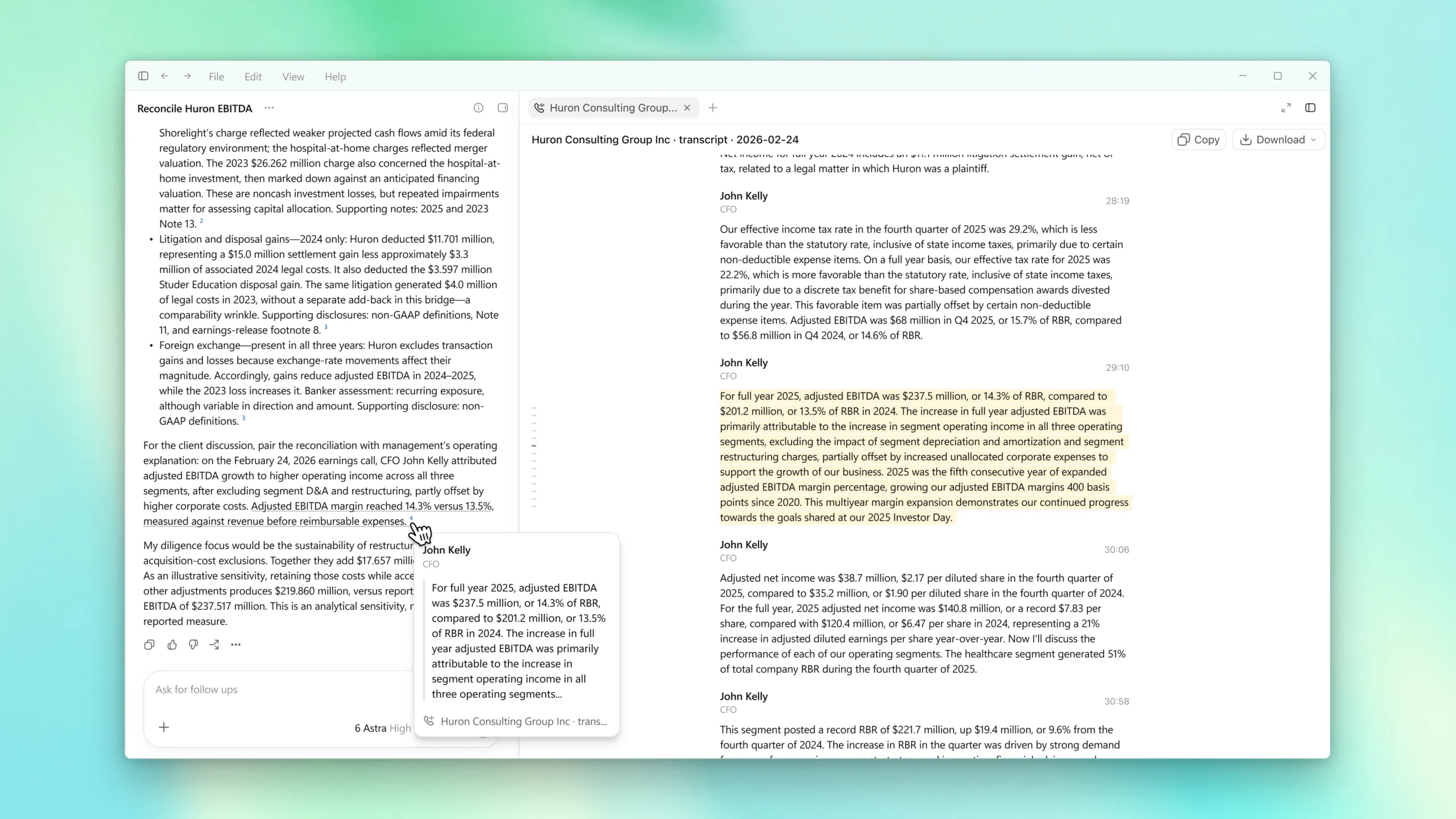
Other practical uses include earnings analysis, screening possible buyers, examining a company’s value drivers, reviewing supporting notes in financial statements, tracing figures across periods and producing research notes with linked evidence.
This is why ChatGPT for Financial Services is more consequential than a new chatbot skin. It is built to sit inside an institutional workflow where data, reasoning, documents and firm standards meet.
ChatGPT for Financial Services vs ChatGPT Enterprise
Standard ChatGPT Enterprise already offers enterprise administration, security controls and powerful general-purpose models. The financial-services edition adds a finance-specific operating layer.
| Area | ChatGPT Enterprise | ChatGPT for Financial Services |
|---|---|---|
| General research and writing | Yes | Yes |
| GPT-6 Astra | Depends on workspace availability | Included natively |
| Built-in premium finance datasets | Mostly connector-dependent | Yes |
| Finance-specific source tracing | Depends on tools/sources | Core product design |
| Firm financial templates | General file workflows | Dedicated Excel, Word and PowerPoint template management |
| Finance-optimized connections | General connector ecosystem | Optimized financial-provider connections |
| Initial workflow design | Broad enterprise use | Investment banking and equity research |
The difference is not that ordinary Enterprise cannot do financial analysis. It is that ChatGPT for Financial Services combines the model with curated data, entitlements, firm templates and controls for teams that cannot improvise their data plumbing every time they run a query.
How does it compare with Claude for Financial Services?
OpenAI is not entering an empty market. Anthropic launched Claude for Financial Services in July 2025 and later expanded it with an Excel add-in, financial-data connectors and prebuilt skills for tasks such as discounted-cash-flow modeling and initiating coverage reports.
Both companies are converging on the same basic architecture: a frontier model plus premium data, spreadsheet workflows, source links, enterprise governance and repeatable skills or templates.
OpenAI’s current differentiators include GPT-6 Astra, its built-in data approach, firm-managed document templates and integration with the wider ChatGPT ecosystem. Anthropic has had longer in the finance-specific market and has emphasized Excel, agent skills and connections to financial platforms.
For a large institution, the decision is unlikely to come down to a single benchmark. Data contracts, existing enterprise deployments, security review, Excel behavior, model consistency, connector reliability and cost per completed workflow will matter more.
Security, governance and compliance controls
OpenAI says ChatGPT for Financial Services inherits enterprise controls including SAML single sign-on, SCIM provisioning and role-based access. Business data is not used to train OpenAI’s models by default, according to the company, and data is encrypted at rest and in transit.
Admins can configure workspace retention, control apps and skills by role, and create multiple workspaces to enforce information barriers. Compliance teams can export supported workspace logs through the OpenAI Compliance Platform into existing audit and investigation processes.
Those controls are significant, but they do not remove a financial institution’s own obligations. FINRA’s 2026 oversight material says firms are increasingly implementing GenAI for internal efficiency and information retrieval while continuing to address supervision, data handling, third-party risk and cybersecurity. Our recent analysis of OpenAI rogue AI agents and agent-safety failures shows why permission boundaries, monitoring and human approval matter as AI systems become more autonomous.
The U.S. Treasury released a Financial Services AI Risk Management Framework in February 2026 and later concluded a public-private AI Innovation Series focused on governance, value generation, cybersecurity, risk management and financial stability. The regulatory conversation is moving almost as quickly as the products.
Will ChatGPT for Financial Services replace junior bankers?
This question dominated much of the early social reaction. A highly active Reddit thread about the launch drew more than 100 upvotes within hours, with users debating job displacement, product usefulness, data accuracy and whether the new system is materially different from existing AI tools.
There is a reason for the concern. ChatGPT for Financial Services directly targets work that consumes junior-banker time: data gathering, comparable-company research, model preparation, earnings analysis and presentation creation. It would be unrealistic to claim that this will have no effect on staffing or workflow design.
But automating tasks is not the same as automating the entire job. Investment banking still involves judgment, negotiation, client communication, accountability, deal context and decisions about which assumptions are defensible. AI can reduce the time required to create a first-pass model or deck, but someone still has to decide whether the analysis makes sense and whether it is suitable to put in front of a client.
Morgan Stanley’s earlier AI deployment offers a useful clue. OpenAI says more than 98% of Morgan Stanley Wealth Management advisor teams use its internal AI assistant. The firm did not simply turn a model loose. It developed evaluation frameworks, regression tests and human review around the system. That approach suggests the near-term future is likely to be heavily AI-assisted work rather than fully unsupervised banking.
The main limitations to watch
Availability is restricted. OpenAI says the product is for eligible financial institutions, with access through sales or an account team. This is not a new consumer ChatGPT subscription.
Benchmark performance still leaves room for error. A 69.9% OfficeQA Pro result means hard financial-document tasks can still fail. Performance can also shift as models, prompts and surrounding systems change, which is one reason we track why AI model quality can appear to degrade over time.
Data access still depends on licensing. Built-in datasets help, but institutional users will have different subscriptions, entitlements and compliance rules.
Governance does not disappear because the interface is convenient. Firms still need review rules for material non-public information, client data, model outputs, recordkeeping and third-party dependencies.
What the launch really means for enterprise AI
The bigger story is not that ChatGPT suddenly learned finance. It is that frontier AI vendors are turning general models into vertical operating environments.
OpenAI is bundling GPT-6 Astra with financial data, citations, document creation, firm templates, identity controls and audit tooling. Anthropic is building a similar stack around Claude. S&P Global and other data providers are making their products easier for AI agents to query directly.
That changes the competitive question. In financial services, the winning system may not simply be the model with the highest intelligence benchmark. It may be the system that can reliably combine licensed data, strong reasoning, transparent sources, controlled actions and the exact formats a firm already uses.
For banks and research teams, ChatGPT for Financial Services is worth watching not because it instantly eliminates analysts, but because it attacks the expensive handoffs between research, data retrieval, spreadsheets, documents and presentations.
FAQ
Is ChatGPT for Financial Services available to everyone?
No. OpenAI says it is available to eligible financial institutions. Interested firms need to contact OpenAI sales or their account team.
Which model powers ChatGPT for Financial Services?
OpenAI says GPT-6 Astra is included natively, and newer models can be added as they become available.
What financial data does it include?
OpenAI lists built-in datasets from Daloopa, PitchBook, LSEG News and Crunchbase, with additional entitlement integrations involving providers such as S&P Capital IQ, LSEG, MSCI, Dow Jones Factiva and Moody’s.
Can it create financial models and pitchbooks?
Yes. OpenAI says teams can perform research and analysis and turn the results into editable models, research notes and pitchbooks using firm-approved templates.
Does OpenAI train on a bank’s business data?
OpenAI says business data in its enterprise products is not used to train its models by default.
Is it accurate enough to work without human review?
No. OpenAI reports clear improvements on finance-related benchmarks, but the published OfficeQA Pro score of 69.9% is itself a reason to keep human verification in high-stakes workflows.
Sources: OpenAI, Reuters, FINRA, U.S. Treasury, Anthropic and S&P Global.